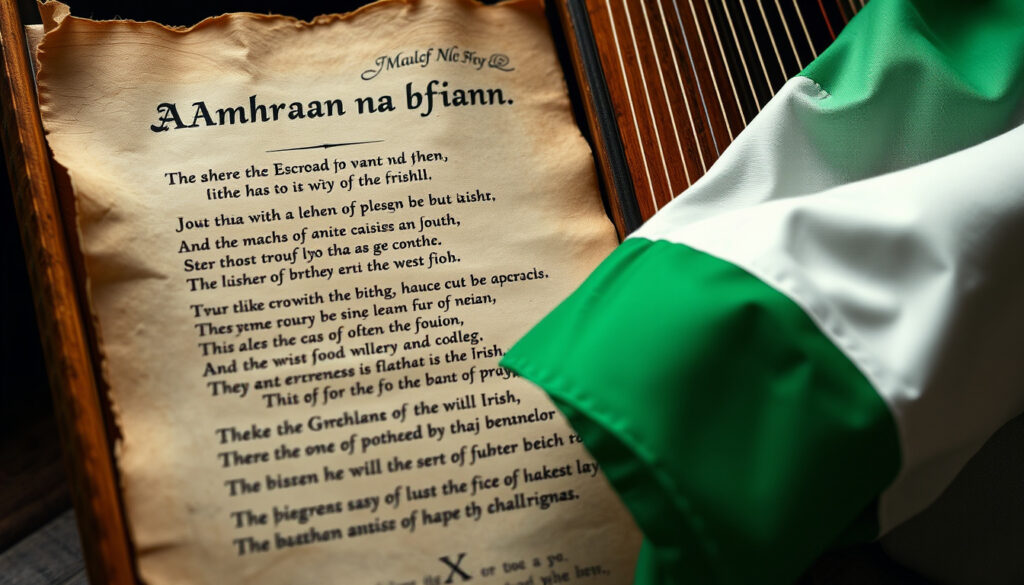
Amhrán na bhFiann Lyrics: Irish and English Translation + History
Few songs carry the weight of a nation’s identity quite like Ireland’s national anthem. What began as a rebel song written in a Dublin café became the official anthem of the Irish Free State in 1926 — yet its journey from English to Irish, and the lyrics that now roar from the terraces of Croke Park, hold more nuance than many realise. Here is the full story of Amhrán na bhFiann, with both the Irish and English lyrics, a line‑by‑line translation, and the history that shaped it.
Year written: 1907 ·
Official adoption: 1926 ·
Original language: Irish (Gaeilge) ·
Number of verses: 3 (usually first sung) ·
English title: The Soldier’s Song
Quick snapshot
- Peadar Kearney wrote the lyrics in 1907; Patrick Heeney composed the music (IrishCentral (Irish diaspora news))
- Adopted as the official national anthem in 1926 (History Ireland (historical journal))
- The anthem is performed in Irish today (Irish Post (Irish‑British weekly))
- The exact date of adoption in 1926 is sometimes debated (July vs. September) (History Ireland (historical journal))
- Whether the third verse is officially part of the national anthem is not universally agreed (History Ireland (historical journal))
- 1907: Poem written → 1916: Sung at the GPO during the Easter Rising → 1926: Adopted as state anthem
- Anthem continues to be used at state ceremonies, sports events, and cultural occasions; growing interest in pronunciation resources for learners
Below is a quick-reference summary of the anthem’s key details.
| Field | Value |
|---|---|
| Title (Irish) | Amhrán na bhFiann |
| Title (English) | The Soldier’s Song |
| Lyricist | Peadar Kearney |
| Composer | Patrick Heeney |
| Adopted | 1926 |
| Language | Irish (Gaeilge) |
| Number of verses | 3 (first verse commonly sung) |
| Official status | National anthem of Ireland |
What does Amhrán na bhFiann mean?
The title Amhrán na bhFiann translates directly to “The Song of the Warriors” or “The Soldier’s Song” in English. The word Fiann refers to the legendary band of warriors from Irish mythology, the Fianna — a deliberate echo that ties the anthem to a pre‑Christian martial tradition. The lyricist Peadar Kearney chose the phrase Sinne Fianna Fáil (We are the soldiers of Destiny) to open the refrain, invoking both myth and the struggle for Irish independence (SongsInIrish.com (Irish language song resource)).
Literal translation of the Irish title
- Amhrán — song
- na bhFiann — of the warriors / of the Fianna
So the meaning is plain: a song belonging to the warriors. But the symbolic weight is heavier, as the anthem pledges “to fight for Irish freedom” (IrishCentral (Irish diaspora news)).
Kearney’s choice of Fianna over a generic word for “soldier” rooted the anthem in a mythology that predates British rule, giving the independence movement a cultural legitimacy that English‑language songs could not claim. Irish Post (Irish‑British weekly)
The implication: what appears as a simple title is actually a layered political statement, merging myth with modern nationalism.
What are the full lyrics of Amhrán na bhFiann in Irish and English?
The anthem officially has three verses, but only the first verse and refrain are routinely sung at official occasions. Below are the Irish lyrics as standardised by the state, the English original, and a pronunciation guide for the first verse.
Irish lyrics (first verse and refrain)
Seo dhibh a cháirde duan Óglaigh,
Cathréimeach briomhar ceolmhar,
Ár dtinte cnámh go buacach táid,
’S an spéir go min réaltogach.
Is fada a bheidh ar státaire,
Is gan cead againne éalú,
Go dtí go mbeidh an lá le n‑ár linn,
Is go dtógfar chun cinn an saol.Refrain:
Sinne Fianna Fáil,
Atá faoi gheall ag Éirinn,
Buíon dár slua,
Thar toinn do ráinig chugainn,
Faoi mhóid bheith saor,
Seantír ár sinsir feasta,
Ní fhágfar faoin tíorán ná faoin tráill.
Anocht a théam sa bhearna bhaoil,
Le gean ar Ghaeil chun báis nó saoil,
Le guna scréach faoi lámhach na bpiléar,
Seo libh canaídh Amhrán na bhFiann.
SongsInIrish.com (Irish language song resource) provides the full Irish text.
English lyrics (A Soldier’s Song – first verse)
We’ll sing a song, a soldier’s song,
With cheering, rousing chorus,
As round our blazing fires we throng,
The starry heavens o’er us.
Impatient for the coming fight,
And as we wait the morning’s light,
Here in the silence of the night,
We’ll chant a soldier’s song.Refrain:
Soldiers are we, whose lives are pledged to Ireland,
Some have come from a land beyond the wave,
Sworn to be free, no more our ancient sireland,
Shall shelter the despot or the slave.
Tonight we man the “bearna bhaoil”,
In Erin’s cause, come woe or weal,
’Mid cannon’s roar and rifles’ peal,
We’ll chant a soldier’s song.
This English version was written by Peadar Kearney and later translated into Irish by Liam Ó Rinn (History Ireland (historical journal)).
Pronunciation guide (first line)
- Seo dhibh a cháirde duan Óglaigh — “Shoh yiv uh KHAWR‑zhuh doo‑uhn OH‑glee”
- Sinne Fianna Fáil — “SHIN‑uh FEE‑uh‑nuh FAWL”
For a full audio guide, see the resources from Gaelscoil Online (Irish language learning site).
The English version — the one Kearney actually wrote first — is now rarely heard publicly. Yet it remains the version that carries the original militant intent, while the Irish version has become the ceremonial standard. Irish Post (Irish‑British weekly)
The pattern: two languages, two audiences — one for the independence movement, one for the modern state — yet the same tune binds them.
The table below shows the first verse of the anthem in Irish and English, line by line.
| Irish line | English line | Literal meaning |
|---|---|---|
| Seo dhibh a cháirde duan Óglaigh | We’ll sing a song, a soldier’s song | Here to you, friends, a song of warriors |
| Cathréimeach briomhar ceolmhar | With cheering, rousing chorus | Triumphant, vigorous, musical |
| Ár dtinte cnámh go buacach táid | As round our blazing fires we throng | Our bone-fires are blazing triumphantly |
| ’S an spéir go min réaltogach | The starry heavens o’er us | And the sky is smooth and starry |
What language is Amhrán na bhFiann in?
The official language of the national anthem is Irish (Gaeilge). Since its adoption in 1926, the state has performed and published the anthem exclusively in that version at official occasions (Government of Ireland (circular on national anthem)). The English version, though historically prior, holds no official standing — it is effectively a translation.
Irish as the primary language
- The constitution designates Irish as the first official language of the Republic.
- The anthem is taught in Irish in schools.
- At state funerals and presidential inaugurations, only the Irish version is sung.
Historical context of Irish language use
Kearney wrote “A Soldier’s Song” in English in 1907. The Irish translation, widely attributed to Liam Ó Rinn and possibly composed as early as 1917, gained popularity during the War of Independence. When the state formally adopted the anthem, the Irish version had already become the people’s choice (History Ireland (historical journal)).
The anthem’s language shift mirrors Ireland’s broader cultural revival — a deliberate move away from the coloniser’s tongue.
The shift from English to Irish was not just linguistic but political, cementing the anthem’s role in nation‑building.
Why were two national anthems sung in 30 words?
The phrase refers to the 1924 Paris Olympics, where the Irish team competed under the Irish Free State banner. When an Irish athlete won a medal, the organisers were unsure which anthem to play. The compromise: they played both “Amhrán na bhFiann” and “God Save the King” — a 30‑word description that captures the political tension of a partitioned island (Irish Post (Irish‑British weekly)).
The 1924 Paris Olympics incident
- Irish athletes competed independently for the first time.
- No single anthem was recognised for the Free State by the IOC.
- The incident underscored the incomplete nature of independence after the Anglo‑Irish Treaty.
Context of Ireland’s partition
The episode is a vivid example of how a national symbol can become a diplomatic puzzle. The 30‑word summary — “two national anthems were played for the Irish team” — often appears in short‑form histories as a shorthand for the awkwardness of early statehood.
The trade‑off: a moment of pride for Irish athletes, but one that exposed the unfinished business of 1922.
What is the history and significance of Amhrán na bhFiann?
The anthem’s path from café song to state symbol is dotted with key figures, dates, and political shifts. Below is the timeline of its journey.
Timeline
- 1907 — Peadar Kearney writes the poem “A Soldier’s Song” (IrishCentral (Irish diaspora news)).
- 1916 — Sung at the GPO during the Easter Rising; spreads among prisoners (Irish Post (Irish‑British weekly)).
- 1924 — Paris Olympics incident where both anthems were played.
- 1926 — Officially adopted as the national anthem of the Irish Free State (History Ireland (historical journal)).
- 1930s — Irish translation by Liam Ó Rinn becomes the standard.
- Present — Used at state events, GAA matches, and cultural festivals.
Who wrote the anthem?
Peadar Kearney (1883–1942) wrote the lyrics; Patrick Heeney composed the melody. Kearney was a Fenian and a friend of Patrick Pearse, and the song’s militant tone reflects the revolutionary mood of the time (IrishCentral (Irish diaspora news)).
When was it adopted?
Adopted in 1926, though the exact month (July or September) is disputed (History Ireland (historical journal)).
What is the Fenian connection?
Kearney was a member of the Fenian movement, which sought Irish independence through physical force. The anthem’s refrain — “Sworn to be free, no more our ancient sireland / Shall shelter the despot or the slave” — directly echoes Fenian ideology.
Usage in modern Ireland
Today the anthem is played before major sports matches, at state ceremonies, and during official visits abroad. Since 2015, the Irish government has published guidelines for its use, including a recommended tempo and the requirement to stand during its performance.
The implication: a song born in a café is now a legal instrument of the state, complete with protocol and copyright.
What we know and what remains unclear
Confirmed facts
- Peadar Kearney wrote the Irish lyrics in 1907. (IrishCentral)
- The anthem was adopted in 1926. (History Ireland)
- The official language is Irish. (Government of Ireland)
- The English original was written by Kearney. (History Ireland)
- Liam Ó Rinn created the Irish translation. (History Ireland)
- The anthem was sung at the GPO in 1916. (Irish Post)
What’s unclear
- Exact adoption date (July vs. September 1926).
- Whether the third verse is officially part of the anthem.
- Which café Kearney wrote the song in (anecdotal accounts differ).
“The official national anthem of the Irish State for over 115 years.”
— IrishCentral (Irish diaspora news)
“The anthem had been sung at the GPO during the Easter Rising.”
— Irish Post (Irish‑British weekly)
youtube.com, walkingholidayireland.com, en.wikipedia.org, tiktok.com, youtube.com, reddit.com, open.spotify.com
Frequently asked questions
How is Amhrán na bhFiann pronounced?
A basic guide: “Am‑hrawn‑na‑VEE‑un”. For a full breakdown, the Gaelscoil Online pronunciation resource is recommended (Gaelscoil Online (Irish language learning site)).
Is it illegal to sing the Irish national anthem?
No, singing it is not illegal. However, commercial use or playing it in a way that “brings it into disrepute” may be regulated under Irish law.
Can I use the anthem for commercial purposes?
Permission is generally required. The government advises contacting the Department of the Taoiseach for commercial use.
What does “Sinne Fianna Fáil” mean?
It means “We are the warriors of Destiny” or “We are the soldiers of Fál” (Fál being an ancient name for Ireland).
Is there a standard tempo for the anthem?
Yes, the official tempo is 104 beats per minute in 4/4 time, as specified by the Irish Defence Forces.
Where can I download an official recording of Amhrán na bhFiann?
Official recordings are available on the Irish government’s website and through the Irish Defence Forces band library.
Why is the anthem sometimes called “The Soldier’s Song”?
That was the original English title given by Peadar Kearney. The Irish translation later became the official version, but the English title persists in common usage.
For the Irish state, Amhrán na bhFiann is more than protocol — it is a living bridge between a revolutionary past and a bilingual present. For learners and visitors, the choice is clear: learn the Irish version to sing with the crowd, but understand the English original to grasp the fire that started it.
More related posts
 Crocodile Dundee Cast: Hogan, Kozlowski, and Where They Are Now
 Nail Salon Near Me: Pregnancy Safety, Tipping & Cost
 What Age Is Priscilla Presley? Her Biography & Life
 Pat Kenny Sign Off: Farewell to Weekday Newstalk Show
 How Many Calories in a Glass of White Wine? Complete Guide
 Novena to St. Jude: 9-Day Prayer for Desperate Causes
 Is Lucy Letby Still in Prison? 2026 Full Status Update
 Bologna FC vs Celtic F.C. Lineups: Confirmed XI & Subs