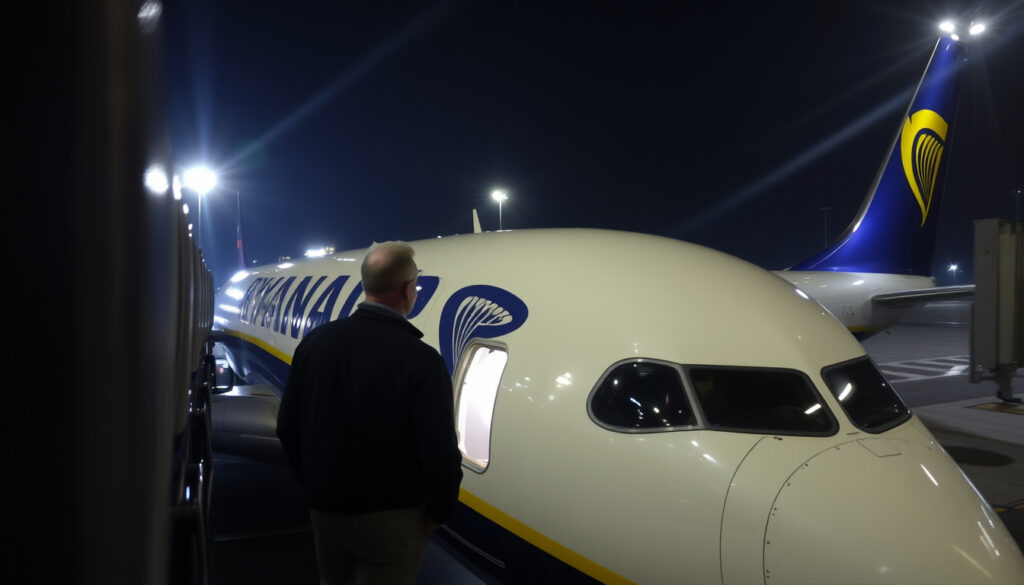
Ryanair window seat response: What happened and what it means
Anyone who’s ever squeezed into a Ryanair window seat knows the drill: you pay extra for the view, and sometimes the view is more… eventful than expected. On July 10, 2026, a passenger on a Ryanair flight from Thessaloniki to Memmingen got an unexpected close-up when a window panel dislodged shortly after takeoff, prompting the aircraft to return to Thessaloniki.
Ryanair window incidents (2026): 2 reported (BBC, The Guardian) · Ryanair seat 11A complaint: Window less than 3 inches wide (Dublin Live) · Ryanair passenger count (2025): 200 million (Ryanair annual report) · Window seat fee: €4–€12 per flight (Ryanair Help Centre) · Check-in window: 24 hours before departure · 40-minute rule boarding closes: 40 minutes before departure (Ryanair)
Quick snapshot
- Investigation report expected from North Macedonia with EASA/FAA input (Reuters)
- Possible airworthiness directive for Boeing 737-800 window seals (Reuters)
- Ryanair may face renewed scrutiny over seat-allocation fees and family seating (Dublin Live)
Six key facts, one pattern: the window incident is only the most visible symptom of a broader tension between Ryanair’s ultra-low-cost model and passenger expectations around safety, comfort, and transparency.
| Fact | Detail | Source |
|---|---|---|
| Incident date | July 10, 2026 | BBC News |
| Flight route | Thessaloniki (Greece) → Memmingen (Germany) | CNN |
| Window location | Passenger window, seat row not specified | BBC News |
| Aircraft type | Boeing 737-800 | Reuters |
| Investigation lead | North Macedonia (airspace overflown) | ABC News |
| EASA involvement | Technical advisor appointed | Reuters |
| FAA involvement | In contact with EASA and Boeing | Reuters |
| Passenger medical assistance | 1 passenger requested assistance on ground | CNN |
| Replacement aircraft departure | 9:53 AM local time | CNN |
| Ryanair response disputed | Airline says crew followed procedures; some passengers disagree | USA Today |
Is seat F on Ryanair a window seat?
On Ryanair’s Boeing 737-800s, seat F is indeed the right-side window seat. Seat A is the left-side window. This configuration is standard for the 737 family, though on Airbus A320-family aircraft (which Ryanair does not operate) the lettering differs. The consistency matters because Ryanair charges extra for seat selection — typically €4 to €12 per flight — and passengers who want a guaranteed view often choose F or A.
The catch: not all “window” seats are created equal. Seat 11A on Ryanair’s 737-800 was famously reported to have a window less than 3 inches wide, making it nearly useless for a view (Dublin Live). The airline’s seat maps show that rows 1, 11, and 17 have reduced window sizes due to fuselage curvature or emergency equipment placement.
Paying extra for a window seat on Ryanair doesn’t guarantee a panoramic view. The airline’s seat allocation system is designed to maximise revenue, not passenger sightlines. For many travellers, the random seat allocation (free if you check in 24 hours ahead) is a better gamble — unless you absolutely need the aisle.
The pattern: paying for a window seat on Ryanair is a gamble, and the July 2026 incident underscores how even a confirmed window seat can become a safety concern.
What are the best window seats on Ryanair?
If you’re set on a window, rows 3–5 on the 737-800 offer the best combination of window size and proximity to the front for quicker exit. Rows 7–9 on the A320 (used by Ryanair subsidiary Lauda) are similarly good. Avoid rows 1, 11, and 17 — the windows are significantly smaller or missing entirely.
Where not to sit on Ryanair?
- Row 11A: “Window” is less than 3 inches wide — essentially a porthole.
- Row 1: No window due to cockpit bulkhead curvature.
- Row 17: Window partially blocked by emergency exit door mechanism.
- Rows 31–33: Rear lavatories and galley noise, plus limited recline.
Is 12F a window seat?
Yes, seat 12F is a window seat on the right side of the 737-800. It sits just behind the overwing exit row and has a full-sized window. It’s a decent choice for travellers who want a view without the premium price of rows 3–5.
The implication: Ryanair’s seat map is a minefield of trade-offs. The best strategy is to pay for a seat in a known good row, or accept random allocation and hope for the best.
How did Ryanair respond to the window seat incidents?
Ryanair’s public response to the July 10 incident was swift but measured. The airline confirmed that the aircraft returned to Thessaloniki, landed normally, and that passengers were bussed back to the terminal (BBC News). It also stated that a replacement aircraft departed at 9:53 AM local time (CNN).
However, the airline later disputed claims that the crew failed to respond appropriately. In a statement to USA Today, Ryanair said procedures require crew to remain seated with seatbelts fastened and oxygen masks on during rapid decompression. The airline also said the passenger was later moved to another seat next to his wife and that an onboard doctor assisted him.
Beyond the incident, Ryanair’s broader response to window seat complaints has been minimal. The airline has not changed its seat allocation algorithm or introduced a “window seat guarantee” despite repeated media coverage of the 11A issue. The Helsinki incident in 2025, where a window cracked mid-flight, also drew no policy change (The Guardian).
Ryanair faces a structural problem: its low-cost model depends on squeezing every inch of cabin space, and windows are a casualty. When an incident like the July 2026 window dislodgement occurs, the airline’s defensive posture — disputing accounts, citing procedures — erodes trust faster than a policy change would rebuild it.
The takeaway: Ryanair’s response, while procedurally correct, fails to address the underlying tension between revenue optimization and passenger safety.
What is the 40-minute rule for Ryanair?
Ryanair requires all passengers to be checked in and have their boarding passes ready at the gate 40 minutes before departure. After that, boarding closes and you cannot fly. The rule is strictly enforced: if you arrive at the gate at 39 minutes, you’re denied boarding. This policy applies to all flights, and Ryanair has been known to refuse rebooking on the same day without a fee.
The catch: the 40-minute rule is often cited in passenger complaints about missed flights, especially when Ryanair’s online check-in system glitches or baggage drop queues are long. The airline’s Help Centre states that no exceptions are made for late arrivals, even if the delay is due to Ryanair’s own check-in lines.
Timeline of the 2026 Ryanair window incident
- July 10, 2026: Ryanair flight FR-??? departs Thessaloniki, window dislodges shortly after takeoff. Aircraft returns to Thessaloniki, lands normally. One passenger requests medical assistance. Fraport Greece activates emergency procedures (BBC News).
- July 10, 2026: Replacement aircraft departs Thessaloniki at 9:53 AM local time (CNN).
- July 13, 2026: European Union Aviation Safety Agency appoints a technical advisor to the investigation, led by North Macedonia under ICAO Annex 13 (Reuters).
- July 22, 2026: USA Today reports that the NTSB may assume control of the investigation, citing the Associated Press. Ryanair disputes crew response claims (USA Today).
- Ongoing: Investigation continues; EASA says it will follow closely and take any continued airworthiness action needed (Reuters).
The sequence shows a swift operational response but a growing regulatory and public relations challenge for Ryanair.
What’s confirmed and what’s still unclear
Confirmed facts
- Window dislodged on Ryanair 737-800 shortly after takeoff from Thessaloniki (BBC News)
- Aircraft returned safely; passengers disembarked normally (CNN)
- One passenger received medical assistance; an onboard doctor helped (USA Today)
- North Macedonia leads investigation; EASA, FAA involved (Reuters)
- Ryanair replaced the aircraft; onward flight departed at 9:53 AM (CNN)
What’s unclear
- Exact cause of the window dislodgement — investigation ongoing (BBC News)
- Whether the passenger was “partially sucked out” — reports conflict (USA Today)
- Precise timing of crew actions during decompression (USA Today)
- Whether the window was a known defect or maintenance issue (BBC News)
- Full account of the passenger’s injuries (CNN)
The balance of evidence confirms the core facts but leaves key details unresolved, underscoring the need for a thorough investigation.
Quotes from the incident
“The aircraft landed normally and passengers returned to the terminal. The replacement aircraft departed Thessaloniki at 9:53 AM local time.”
— Ryanair spokesperson, CNN
“All necessary measures were taken with airport stakeholders and emergency services to ensure safe management of the incident.”
— Fraport Greece statement, CNN
“The European Union Aviation Safety Agency has appointed a technical advisor to support the investigation led by the Republic of North Macedonia.”
— EASA spokesperson, Reuters
“Procedures require crew to remain seated with seatbelts fastened and oxygen masks on during rapid decompression.”
— Ryanair statement to USA Today
The core tension: Ryanair’s operational narrative — “we followed procedures, everything was fine” — clashes with the visceral experience of a window panel coming off mid-flight. The more the airline defends its processes, the less it addresses the passenger’s fear.
ryanair.com, theguardian.com, air-journal.fr, extra.ie, telegraph.co.uk, bloomberg.com
The airline’s handling of the window seat controversy has drawn attention alongside Ryanairs recent route cuts, which have affected millions of passengers across Europe.
Frequently asked questions
Do I really need to print my Ryanair boarding pass?
Ryanair requires a physical boarding pass or a digital pass on the app. If you check in online, you can use the app, but if you don’t have a smartphone, you must print at home or pay a fee at the airport.
Do Ryanair give you a free seat 24 hours before takeoff?
Yes, if you check in online 24 hours before departure, you can get a randomly assigned seat for free. However, that seat may be in the middle or aisle — window seats are not guaranteed.
What happened in the 2026 Ryanair window incidents?
On July 10, 2026, a window panel dislodged on a Ryanair Boeing 737-800 shortly after takeoff from Thessaloniki, Greece. The aircraft returned to the airport, and one passenger requested medical assistance. The investigation is led by North Macedonia with EASA and FAA involvement.
Is seat 11A on Ryanair a window seat?
Yes, seat 11A is a window seat, but the window is less than 3 inches wide, making it more of a porthole. It’s widely considered the worst window seat on the 737-800.
Are window seats included in random seat allocation?
Yes, random seat allocation can assign you a window seat, but it’s not guaranteed. To secure a window seat, you must pay the seat selection fee (€4–€12).
Did a man almost get sucked out of a Ryanair window?
Reports vary. Some sources say the passenger was “partially sucked out” by the decompression, but Ryanair and other officials have not confirmed that detail. The investigation is ongoing.
Related reading
- Storm Amy Coming to Ireland — travel disruption updates that can affect flight schedules
- Beast from the East Alert: Met Eireann Issues 2026 Warning — weather-related travel safety advice for Ireland
For travellers who fly Ryanair regularly, the lesson is clear: know your seat map, check in on time, and be prepared for the airline’s inflexible rules. For the European aviation industry, the July 2026 window incident is a reminder that cost-cutting and safety can collide — and when they do, the regulator’s response matters as much as the airline’s.
More related posts
 200 Sterling to Euro: Best Rate & Fee Comparison
 Sir John Rogerson’s Quay: History, Location & Dublin Guide
 Red Hot Chili Peppers: Members, Hits, History & Facts
 Death on the Nile Controversy, Box Office & Worth Watching (2022)
 Snow in New York: Seasonal Snowfall, Records & Forecasts
 Real Madrid vs FC Barcelona: El Clásico titles, stream & history
 Where to Find Cheap Textbooks: Best Websites & Tips