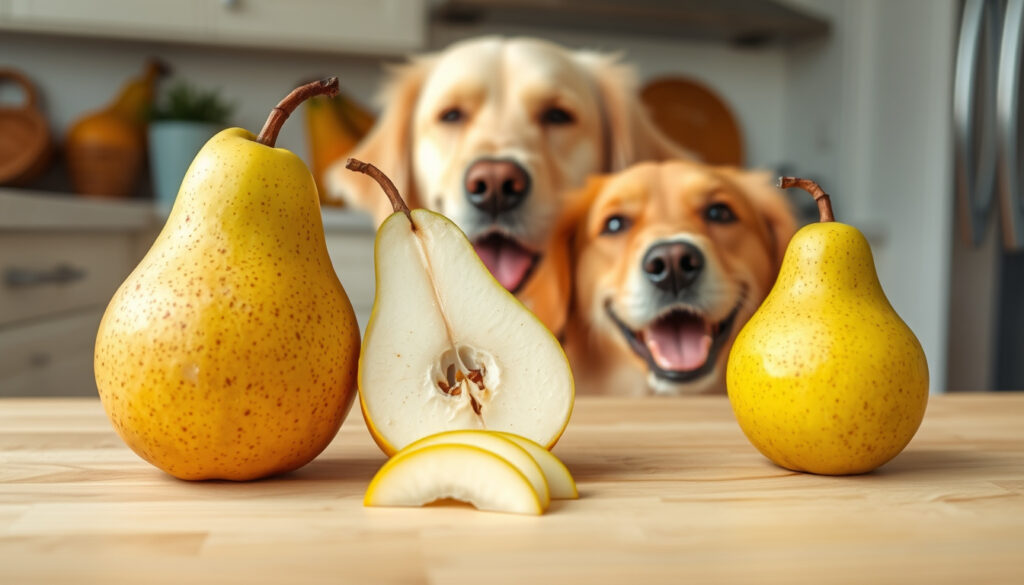
Can Dogs Eat Pears? Safety, Benefits & Feeding Tips
You’re standing in the produce aisle, a ripe pear in hand, and your dog gives you that look — the one that says “share with me.” Good news: pears are one of the safer fruits you can offer your pup, as long as you know exactly which parts to avoid.
Safe for dogs: Yes, in moderation · Recommended serving size: 1-2 small slices per day · Canned pears: Not recommended (high sugar) · Pear seeds: Toxic (contain cyanide) · Pear skin: Safe if washed thoroughly
Quick snapshot
- Rich in vitamin C and K (PetMD veterinary review)
- Contains fiber for digestion (American Kennel Club)
- Low in calories, good for weight management (Purina US pet nutrition)
- Seeds contain cyanide (PetMD veterinary review)
- Canned pears have added sugar (Purina US pet nutrition)
- Overfeeding can cause gastrointestinal upset (American Kennel Club)
- Wash and peel if desired (PetMD veterinary review)
- Remove core and seeds (American Kennel Club)
- Cut into small, bite-sized pieces (Purina US pet nutrition)
- Bartlett, Bosc, Anjou (The Farmer’s Dog canine nutrition)
- Asian pears are also safe (PetMD veterinary review)
- Avoid any with mold or bruises (American Kennel Club)
Five key facts, one pattern: pears are safe only when you control what goes into your dog’s bowl — the flesh is fine, but the extras (seeds, syrup, skin) each carry their own risk.
| Fact | Detail |
|---|---|
| Safety | Pears are safe for dogs in moderation (PetMD veterinary review) |
| Toxic parts | Seeds must be removed (American Kennel Club) |
| Canned pears | Avoid due to added sugar (Purina US pet nutrition) |
| Daily limit | 1-2 small slices for medium dog (PetMD veterinary review) |
| Skin | Safe if washed (PetMD veterinary review) |
The implication: the margin between a healthy treat and a risky one is small — preparation is everything.
Can dogs eat pears skin?
Is pear skin safe for dogs?
- Pear skin is safe and contains fiber (PetMD veterinary review)
- Wash thoroughly to remove pesticides (PetMD veterinary review)
- Avoid if dog has digestive issues (American Kennel Club)
The skin of a pear is technically safe, but it’s also where most pesticide residue sits. A thorough rinse under running water removes the bulk of it. For dogs with sensitive stomachs, peeling the pear eliminates that variable entirely.
The catch: skin adds fiber, which is good for most dogs, but if your dog isn’t used to fiber-rich treats, it can cause loose stools. Start with a small piece of peeled pear first, then try skin-on.
How to prepare pear skin for dogs
- Wash the pear under cold running water for at least 30 seconds (PetMD veterinary review)
- Remove the stem and core (American Kennel Club)
- Cut into small, bite-sized pieces (Purina US pet nutrition)
What this means: a 30-second wash and a quick core removal turn a pear from a potential hazard into a safe, fiber-rich snack.
Dog owners who wash pears thoroughly and start with skin-on pieces give their pets extra fiber without added risk — but dogs with sensitive digestion do better with peeled pears.
Can dogs eat pears seeds?
Are pear seeds toxic to dogs?
- Pear seeds contain amygdalin which can release cyanide (PetMD veterinary review)
- Small amounts may cause mild upset, large amounts dangerous (American Kennel Club)
- Always remove seeds before feeding (Purina US pet nutrition)
Pear seeds contain amygdalin, a compound that can release cyanide when chewed and digested. The amount in a few seeds is unlikely to harm a medium-sized dog, but the risk scales with quantity and size. A small dog that eats the core of an entire pear faces a real danger.
The trade-off: the flesh is perfectly safe, but the seeds are a gamble no owner should take. Remove the core entirely — it takes five seconds and eliminates the risk.
Symptoms of cyanide poisoning
- Difficulty breathing (PetMD veterinary review)
- Bright red gums (American Kennel Club)
- Vomiting and diarrhea (Purina US pet nutrition)
If your dog eats a significant number of seeds — say, the cores of several pears — watch for these signs. Most cases involve mild stomach upset, but severe poisoning requires immediate veterinary attention.
What to do if dog eats pear seeds
- Monitor for symptoms (American Kennel Club)
- Contact your veterinarian if concerned (PetMD veterinary review)
- Keep the seed quantity in perspective (Purina US pet nutrition)
The pattern: a single pear’s worth of seeds is rarely an emergency, but it’s also completely avoidable. Core first, serve second.
A small dog that chews through an entire pear core — seeds, stem, and all — faces a real cyanide risk. For owners of toy breeds, even one core is too many.
Can dogs eat pears canned?
Why canned pears are not recommended
- Canned pears often contain added sugar or syrup (Purina US pet nutrition)
- High sugar can cause digestive upset and obesity (American Kennel Club)
- Plain fresh pears are the best choice (PetMD veterinary review)
Canned pears are packed in heavy syrup or fruit juice, both of which spike sugar content far beyond what a dog’s digestive system handles well. A single serving of canned pears in syrup can contain 15-20 grams of sugar — roughly the same as a chocolate chip cookie for a 30-pound dog.
The catch: even “no sugar added” canned pears often contain natural fruit juice concentrate, which still raises sugar levels. Fresh pears give you full control over what your dog eats.
Sugar content in canned pears
- Heavy syrup: ~18g sugar per 100g (Purina US pet nutrition)
- Light syrup: ~12g sugar per 100g (Purina US pet nutrition)
- Fresh pear: ~10g sugar per 100g (PetMD veterinary review)
The difference between fresh and canned isn’t just sugar — it’s the type. Fresh pears contain natural fructose with fiber that slows absorption. Canned pears deliver sugar without that buffer, hitting the bloodstream faster.
Fresh vs canned pears for dogs
- Fresh: lower sugar, more fiber, no preservatives (PetMD veterinary review)
- Canned: higher sugar, softer texture, choking risk lower (Purina US pet nutrition)
- Frozen: safe if thawed and broken into pieces (The Farmer’s Dog canine nutrition)
Why this matters: fresh pears win on every metric that matters for a dog’s health — lower sugar, higher fiber, and no additives. Canned pears are a convenience trade-off that isn’t worth making.
Can dogs eat pears everyday?
How many pears can a dog eat?
- Pears should be an occasional treat, not daily staple (PetMD veterinary review)
- Too much fruit can cause diarrhea (American Kennel Club)
- Recommended portion: a few small slices per day for medium dog (Purina US pet nutrition)
The 10% rule from veterinary nutritionists is the gold standard: treats — including fruit — should make up no more than 10% of a dog’s daily calorie intake. For a 30-pound dog on a standard diet, that’s roughly 2-3 small pear slices per day.
The trade-off: pears are low in calories but high in natural sugar. Daily feeding, even in small amounts, adds up. A few slices a few times a week is the sweet spot.
Daily treat guidelines for dogs
- Small dog (under 20 lbs): 1 small slice (PetMD veterinary review)
- Medium dog (20-50 lbs): 2 small slices (Purina US pet nutrition)
- Large dog (over 50 lbs): 3 small slices (American Kennel Club)
The pattern: portion size scales with body weight, but the principle stays the same — pears are a treat, not a meal replacement.
Signs of overfeeding fruit
- Loose stools or diarrhea (American Kennel Club)
- Excessive gas (PetMD veterinary review)
- Weight gain over time (Purina US pet nutrition)
What this means: if your dog’s stool changes after pear treats, cut back. The fiber and sugar combination can overwhelm a digestive system not used to fruit.
Pears are healthy for dogs in isolation, but the cumulative sugar from daily treats — even healthy ones — can push a dog past its ideal calorie intake. The healthiest treat is the one you don’t give every day.
What fruit can dogs not eat?
Fruits toxic to dogs
- Grapes and raisins: can cause kidney failure (American Kennel Club)
- Citrus fruits: can cause digestive upset (PetMD veterinary review)
- Cherries: pits contain cyanide (Purina US pet nutrition)
Grapes and raisins are the most dangerous — even small amounts can trigger acute kidney failure in some dogs. Citrus fruits like oranges and lemons are less dangerous but can cause vomiting and diarrhea due to their acidity.
The catch: pears sit firmly in the “safe” category alongside apples (without seeds), blueberries, and watermelon (without rind). The difference between safe and toxic often comes down to a single part of the fruit — seeds, pits, or skin.
Safe fruits for dogs
- Apples (no seeds) (American Kennel Club)
- Blueberries (PetMD veterinary review)
- Watermelon (no rind) (Purina US pet nutrition)
- Bananas (in moderation) (American Kennel Club)
The pattern: safe fruits share one trait — they’re low in toxic compounds and easy to prepare. The unsafe ones either contain systemic toxins (grapes) or have parts that are dangerous (cherry pits, citrus oils).
How to introduce new fruits
- Start with a small piece (PetMD veterinary review)
- Wait 24 hours for any reaction (American Kennel Club)
- Consult your vet before introducing new foods (Purina US pet nutrition)
Why this matters: every dog is different. A fruit that’s safe for one dog might cause an allergic reaction in another. The 24-hour wait rule is the simplest way to catch a problem before it becomes an emergency.
Dog owners who learn the difference between safe and toxic fruits — and prepare each one correctly — give their pets variety without risk. Pears are a perfect example: safe flesh, dangerous seeds, and a simple preparation rule that makes all the difference.
Pros and cons of feeding pears to dogs
Upsides
- Rich in vitamins C and K (PetMD veterinary review)
- Contains dietary fiber for digestion (American Kennel Club)
- Low in calories — good for weight management (Purina US pet nutrition)
- Most dogs enjoy the sweet taste (The Farmer’s Dog canine nutrition)
Downsides
- Seeds contain cyanide — must be removed (PetMD veterinary review)
- Canned pears have added sugar — not recommended (Purina US pet nutrition)
- Overfeeding can cause diarrhea (American Kennel Club)
- Choking hazard if not cut into small pieces (American Kennel Club)
The trade-off: pears offer real nutritional benefits, but the preparation effort and portion control required mean they’re not a grab-and-go treat. For owners willing to spend 60 seconds prepping, they’re one of the better fruit options.
How to prepare pears for dogs: step-by-step
Step 1: Choose the right pear
- Select a ripe, firm pear without bruises or mold (PetMD veterinary review)
- Avoid unripe pears — they can cause stomachache (The Farmer’s Dog canine nutrition)
- Bartlett, Bosc, Anjou, and Asian pears are all safe (PetMD veterinary review)
Step 2: Wash thoroughly
- Rinse under cold running water for 30 seconds (PetMD veterinary review)
- Scrub gently to remove pesticide residue (PetMD veterinary review)
- Pat dry with a clean towel (American Kennel Club)
Step 3: Remove core, stem, and seeds
- Cut the pear in half lengthwise (PetMD veterinary review)
- Scoop out the core and seeds with a spoon (American Kennel Club)
- Remove the stem completely (Purina US pet nutrition)
Step 4: Cut into bite-sized pieces
- Slice into small, manageable pieces (PetMD veterinary review)
- For small dogs: pieces no larger than a pea (American Kennel Club)
- For large dogs: pieces about the size of a blueberry (Purina US pet nutrition)
Step 5: Serve in moderation
- Limit to 1-2 small slices per day for a medium dog (PetMD veterinary review)
- Treats should not exceed 10% of daily calories (Purina US pet nutrition)
- Store cut pears in the refrigerator for up to 3 days (The Farmer’s Dog canine nutrition)
The pattern: five steps, under two minutes, and the result is a treat that’s safer than most commercial dog snacks. The time investment is minimal; the safety payoff is real.
Confirmed facts vs. what’s unclear
Confirmed facts
- Pears are safe for dogs when prepared correctly (PetMD veterinary review)
- Pear seeds contain cyanide and are toxic in large quantities (American Kennel Club)
- Canned pears with added syrup are not recommended (Purina US pet nutrition)
- Pears should be cut into small pieces to prevent choking (American Kennel Club)
What’s unclear
- Exact safe daily portion for all dog sizes (PetMD veterinary review)
- Potential allergic reactions in individual dogs (American Kennel Club)
- Long-term effects of regular pear consumption (Purina US pet nutrition)
The implication: the core safety facts are well-established by veterinary sources, but the individual variables — dog size, sensitivity, and frequency — remain in the owner’s hands. There’s no one-size-fits-all pear portion.
Expert perspectives on pears for dogs
“Pears are a sweet, healthy treat that can be given to dogs in moderation, but the seeds should always be removed.”
— PetMD veterinary review
“Canned pears are not good for dogs because they contain too much sugar, which can irritate the digestive tract.”
— American Kennel Club
“Dogs should only be given pears in moderation and pear treats should not exceed 10% of daily calories.”
— Purina US pet nutrition
“Pears are generally safe when washed, cored, seedless, and served in small portions.”
— The Farmer’s Dog canine nutrition
The consensus across all four sources is consistent: pears are safe with proper preparation, seeds are the main hazard, and moderation is non-negotiable. No source recommends canned pears or daily feeding.
Summary
Pears are one of the safer fruit options for dogs — nutrient-dense, low in calories, and generally well-tolerated — but only when the seeds, core, and stem are removed and the fruit is cut into appropriate sizes. The risk isn’t in the pear itself; it’s in the parts we normally eat around. For dog owners in the US, the choice is clear: serve fresh, washed, cored pears in small portions a few times a week, or skip the fruit entirely and stick with vet-approved commercial treats. The middle ground — canned pears or daily feeding — is where the problems live.
For more detailed guidance on serving sizes and preparation, a comprehensive guide on can dogs eat pears safely offers vet-approved advice for pet owners.
Frequently asked questions
Can puppies eat pears?
Yes, puppies can eat small amounts of fresh pear flesh, but only in tiny pieces. Their digestive systems are more sensitive, so start with a piece no larger than a pea and watch for any reaction (Purina US pet nutrition).
Are Asian pears safe for dogs?
Yes, Asian pears are safe for dogs when prepared the same way as European varieties — washed, cored, seeded, and cut into small pieces (PetMD veterinary review).
Can dogs eat pear cores?
No. Pear cores contain seeds with amygdalin, which can release cyanide. The core is also a choking hazard. Always remove the core before feeding (American Kennel Club).
What are the health benefits of pears for dogs?
Pears provide vitamin C, vitamin K, and dietary fiber. They’re low in calories, making them a good option for weight management when fed in moderation (PetMD veterinary review).
Can dogs eat dried pears?
Dried pears are safe in very small amounts, but they’re much higher in sugar concentration than fresh pears. Check the label for added sugar or preservatives. A single small piece is enough (Purina US pet nutrition).
Can dogs eat pear juice?
Pear juice is not recommended. It lacks the fiber of whole pears and delivers concentrated sugar without the digestive benefits. Stick to fresh pear slices (American Kennel Club).
How should I store cut pears for my dog?
Store cut pears in an airtight container in the refrigerator for up to 3 days. For longer storage, freeze pear slices on a baking sheet, then transfer to a freezer bag. Thaw before serving (The Farmer’s Dog canine nutrition).
Can dogs eat pears and apples together?
Yes, pears and apples can be fed together as long as both are prepared correctly — seeds and cores removed from both, and cut into appropriate sizes. The combination adds variety without increasing risk (PetMD veterinary review).
More related posts
 Anthony Joshua’s Next Fight: Opponent, Date & Fury Blueprint
 Taxi Rank Near Me: Dublin City Centre Guide
 Can I Take 2 Piriton Tablets at Once? Safe Dosing
 Six Nations Fixtures This Weekend: 2026 Schedule, TV & Standings
 Cheapest Prepaid SIM Card Ireland 2026: Compare & Save
 How Old Is Holly Wheeler in Season 5? Age, Recast & Retcon
 Wolves vs Man United: Results, H2H, TV & Predictions
 What Age Is Priscilla Presley? Her Biography & Life