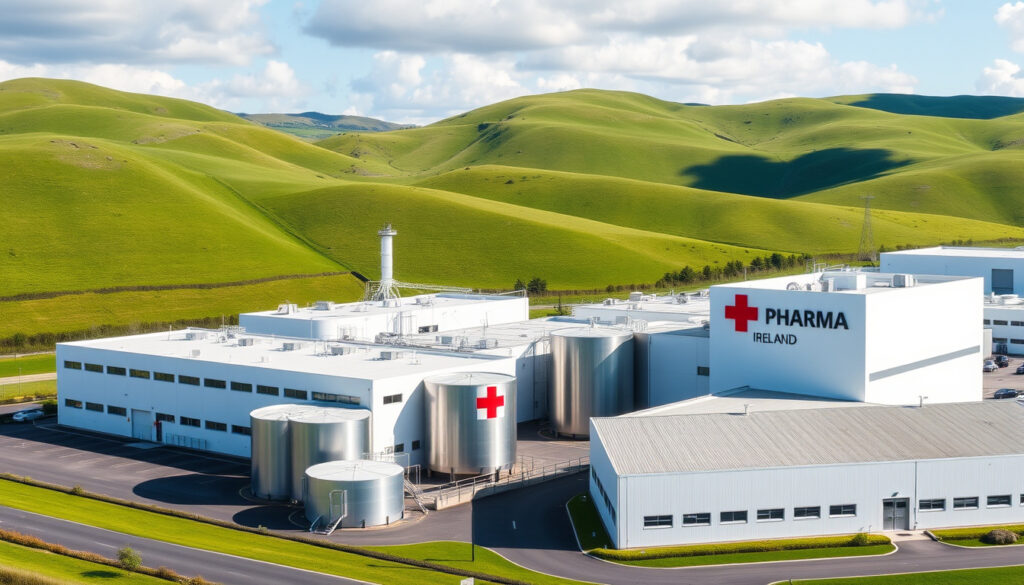
Pharmaceutical Companies in Ireland: Top Players & Factories
Anyone who has read the “Manufactured in Ireland” line on a blister pack and wondered how such a small country ended up supplying so much of the world’s medicine is about to find out. With 213 pharmaceutical and medical-device factories and operations from 9 of the top 10 global pharma companies, Ireland isn’t just a participant in the industry — it’s a dominant hub. This guide walks through the players, the numbers, and the reasons behind the concentration, giving you a fact-based picture of one of Europe’s most important pharma clusters.
Number of pharmaceutical factories in Ireland: 213+ (including medical device) · Global pharma presence: 9 of the world’s top 10 pharmaceutical companies operate in Ireland · Major players: Pfizer, AbbVie, Johnson & Johnson, Novartis, AstraZeneca, Merck, Amgen, Gilead Sciences
Quick snapshot
- Pfizer, AbbVie, Johnson & Johnson, Novartis, AstraZeneca (GetReskilled (pharma job listing and industry analysis))
- 9 of top 10 global pharma companies present (IDA Ireland (national investment promotion agency))
- Over 50 manufacturing sites from these leaders (GetReskilled (pharma job listing and industry analysis))
- 213 pharmaceutical and medical device factories (GetReskilled (pharma job listing and industry analysis))
- Distributed across all provinces (GetReskilled (pharma job listing and industry analysis))
- Dublin, Cork, and Limerick are key clusters (GetReskilled (pharma job listing and industry analysis))
- 12.5% corporate tax rate (IDA Ireland (national investment promotion agency))
- Skilled, English-speaking talent pool (IDA Ireland (national investment promotion agency))
- EU membership and IDA Ireland support (IDA Ireland (national investment promotion agency))
- Home to Pfizer, AbbVie, AstraZeneca, and many more (GetReskilled (pharma job listing and industry analysis))
- Major R&D and manufacturing center (GetReskilled (pharma job listing and industry analysis))
- Access to Dublin’s infrastructure and workforce (GetReskilled (pharma job listing and industry analysis))
Five key data points give a sense of the scale: Ireland’s pharma-medtech footprint spans 213 factories, hosts 9 of the top 10 global companies, and the top employer alone — Pfizer — has been operating in the country since 1969.
| Metric | Value |
|---|---|
| Total pharma & med device factories | 213 |
| Global top 10 pharma companies present | 9 |
| Top employer | Pfizer |
| Corporate tax rate | 12.5% |
| Irish pharmaceutical exports (2023) | €50+ billion (approx.) |
What are the biggest pharmaceutical companies in Ireland?
Pfizer, AbbVie, Johnson & Johnson lead the list
- Pfizer has operated in Ireland since 1969, with multiple sites in Cork, Dublin, and Kildare (R&D Partners (pharma industry recruiting firm); GetReskilled (pharma job listing and industry analysis)).
- AbbVie is listed among the largest pharma employers in Ireland, with sites in Cork, Dublin, Mayo, and Sligo (GetReskilled (pharma job listing and industry analysis)).
- Johnson & Johnson is represented in Cork, Galway, and Limerick (GetReskilled (pharma job listing and industry analysis)).
- Novartis has Dublin-based operations, and AstraZeneca recently invested in advanced manufacturing capacity near Dublin (GetReskilled (pharma job listing and industry analysis); R&D Partners (pharma industry recruiting firm)).
Top 10 by workforce: GetReskilled data
GetReskilled, a pharma-industry job site, provides a running list of the largest pharmaceutical and medical device employers in Ireland by headcount. Their data includes Pfizer, AbbVie, Johnson & Johnson, Novartis, AstraZeneca, MSD (Merck), Lilly, Sanofi, and Bristol Myers Squibb (GetReskilled (pharma job listing and industry analysis)). A separate ranking from a YouTube channel (tier‑3 source) placed AbbVie at number 10, MSD at 9, and Lilly at 8 by workforce size, though exact employee numbers are not publicly detailed per company (YouTube channel (unofficial ranking)).
Global giants with Irish operations
The 12.5% corporate tax rate and IDA Ireland incentives have drawn virtually every top pharma firm. IDA Ireland states: “Ireland is a global hub for pharmaceutical manufacturing, with 9 of the world’s top 10 pharma companies operating here” (IDA Ireland (national investment promotion agency)). Beyond the household names, BiopharmGuy’s directory lists dozens more, from Amgen to UCB, confirming a broad ecosystem (BioPharmGuy (industry directory)).
Pfizer isn’t just the longest‑tenured player — its combination of manufacturing sites across three counties and decades of investment makes it the anchor employer. For job seekers, that translates to the widest range of roles, from process chemistry to regulatory affairs.
The implication: when you hear “top pharma companies in Ireland,” the list is not static — it shifts as mergers and facility expansions occur. But the core group — Pfizer, AbbVie, Johnson & Johnson, Novartis, AstraZeneca — remains consistent across authoritative sources.
How many pharmaceutical factories are there in Ireland?
Total count of 213 factories (including medical device)
GetReskilled’s regularly updated report counts 213 pharmaceutical and medical device factories in Ireland (GetReskilled (pharma job listing and industry analysis)). This figure blends pure pharma manufacturing with medical device production, reflecting the country’s dual strength in both sectors. Lusha’s directory lists 175 pharma‑manufacturing companies in Ireland, a lower number because it excludes medtech firms (Lusha (business data provider)).
Regional distribution: Dublin, Cork, and beyond
- Dublin: Grange Castle (Pfizer), Clonshaugh (AbbVie), plus Novartis, Sanofi, and AstraZeneca sites.
- Cork: Pfizer, Johnson & Johnson, Lilly, MSD (Merck).
- Limerick: Johnson & Johnson, Lilly.
- Other counties: Galway (Johnson & Johnson), Mayo (AbbVie), Sligo (AbbVie), Waterford (Sanofi), Kildare (Pfizer), Wicklow, Offaly, Roscommon (GetReskilled (pharma job listing and industry analysis)).
Growth over the past decades
Ireland’s pharma footprint did not appear overnight. The first major wave came in the 1970s when US companies, encouraged by IDA Ireland, set up shop. The 1990s saw a surge as Pfizer, Johnson & Johnson, and others expanded. By the 2000s, biopharma manufacturing had become a core specialization, with AbbVie, Merck, and Amgen opening new plants. Today the sector is one of the densest in Europe (IDA Ireland (national investment promotion agency)).
The “213 factories” figure includes medical device sites — meaning pure pharma plants are fewer. For investors or analysts, distinguishing between drug substance manufacturing, drug product finishing, and medtech assembly is essential to understand capacity.
The pattern: Ireland’s pharma‑medtech density is unmatched in Europe. With 213 facilities spread across a country smaller than Indiana, the industry has become a backbone of the economy.
Why does Ireland have so many pharmaceutical companies?
Low corporate tax rate (12.5%)
Ireland’s 12.5% corporate tax rate is widely cited as the primary magnet for multinational pharma companies (IDA Ireland (national investment promotion agency)). In an industry where effective tax rates for US and other European countries can exceed 20‑25%, the difference directly affects profit margins and reinvestment capacity. The tax regime is complemented by R&D tax credits that further reduce the cost of innovation.
Skilled, English‑speaking workforce
Ireland’s education system produces a steady pipeline of science and engineering graduates. All major pharma operations communicate in English, removing language barriers that complicate expansions into non-anglophone countries. The talent pool is deep enough to staff everything from aseptic filling lines to quality control labs (IDA Ireland (national investment promotion agency)).
EU membership and IDA Ireland incentives
Access to the European single market — with harmonized regulatory processes via the EMA — makes Ireland a natural launchpad. IDA Ireland actively courts pharmaceutical investments with grants, site selection support, and fast‑track planning. The result is an ecosystem where nine of the world’s top ten pharma companies have chosen to invest (IDA Ireland (national investment promotion agency)).
Why this matters: no single factor explains Ireland’s dominance. The 12.5% tax rate gets headlines, but it’s the combination of tax, talent, English language, EU access, and proactive government support that creates a moat. Replicating even two of these is tough for a competitor country.
Which pharmaceutical companies are located in Dublin?
Pfizer, AbbVie, AstraZeneca, and others in Dublin
Dublin is the most concentrated pharma hub in Ireland. Pfizer’s Grange Castle site in west Dublin is one of its largest manufacturing campuses globally. AbbVie operates a manufacturing site in Clonshaugh, north Dublin (plus another in Sligo). AstraZeneca (formerly Alexion) has a facility in the Dublin area (GetReskilled (pharma job listing and industry analysis); R&D Partners (pharma industry recruiting firm)). Novartis, Sanofi, and Bristol Myers Squibb also have significant Dublin operations.
Key industrial sites and headquarters
- Grange Castle (Pfizer): multi‑product, multi‑technology campus.
- Clonshaugh (AbbVie): biologics and small molecule manufacturing.
- Dublin city centre / suburbs: headquarters for many companies’ Irish operations.
Role of Dublin as a pharma hub
Dublin offers the largest labor pool, proximity to Dublin Airport for supply chain, and the headquarters of the Health Products Regulatory Authority (HPRA). The city’s role goes beyond factories — it houses R&D centers, commercial offices, and supply‑chain management for global operations.
The trade‑off: Dublin’s concentration means higher competition for talent and higher real‑estate costs compared to Cork or Limerick. For companies valuing speed of recruitment and infrastructure, the premium is worth it; for others, the savings of a regional site may be more attractive. Many of these global players have a significant presence, and you can explore Irish pharmaceutical companies for more details.
Who are the big 5 pharmaceutical companies?
Traditional big 5: Pfizer, Merck, Roche, Novartis, Sanofi
The “big 5” label typically refers to Pfizer, Merck, Roche, Novartis, and Sanofi — the five companies that have historically led global pharma revenue and R&D spend. All five have operations in Ireland. Pfizer and Novartis have the deepest manufacturing presence; Merck (MSD in Europe) and Sanofi have multiple Irish sites; Roche has a diagnostics and pharma presence (R&D Partners (pharma industry recruiting firm); GetReskilled (pharma job listing and industry analysis)).
Relevance to Ireland: all have operations in the country
Each of the classic big 5 has maintained Irish operations for years. GetReskilled’s list includes Sanofi (Dublin, Waterford), Novartis (Dublin), and Pfizer (multiple). Merck’s MSD arm is present in Carlow and Cork. Roche operates through its diagnostics and pharma divisions (BioPharmGuy (industry directory)).
Recent shifts in rankings (2025 market cap)
The “big 5” concept is fluid. Mergers (e.g., Pfizer’s acquisition of Wyeth, AbbVie’s spin‑off from Abbott) and new blockbuster drugs (like Ozempic from Novo Nordisk) change the pecking order. By 2025 market capitalization, Novo Nordisk, Eli Lilly, and AbbVie have challenged the traditional top spots. Yet Ireland’s appeal remains: even as rankings shuffle, the country’s pharma‑devoted infrastructure stays essential.
The implication: for anyone tracking “big pharma,” the Irish dimension is consistent. The companies that matter globally invest in Ireland — and the list evolves, but the country’s share of their manufacturing and R&D does not shrink.
Clarity Check
- Low corporate tax rate of 12.5% is a key factor (IDA Ireland (national investment promotion agency))
- 9 of the top 10 global pharma companies have operations in Ireland (IDA Ireland (national investment promotion agency))
- There are at least 213 pharma and medical device factories in Ireland (GetReskilled (pharma job listing and industry analysis))
- Exact ranking of pharmaceutical companies by revenue within Ireland (figures are aggregate per company globally)
- Precise number of employees per company (aggregate data available but not per-company publicly)
Voices from the industry
Ireland is a global hub for pharmaceutical manufacturing, with 9 of the world’s top 10 pharma companies operating here.
— IDA Ireland (national investment promotion agency)
Our list of the top pharmaceutical companies in Ireland includes Pfizer, AbbVie, Johnson & Johnson, Novartis, and AstraZeneca, each with multiple sites across the country.
— GetReskilled (pharma job listing and industry analysis)
The perspective from both a government agency and an industry job board reinforces the same message: Ireland’s pharma sector is both broad and deep. The companies that people search for are real employers with real factories.
Summary
Ireland didn’t stumble into its pharmaceutical prominence — it was built over five decades through deliberate policy, a skilled workforce, and strategic location. With 213 factories, 9 of the top 10 global players, and an ecosystem that spans R&D to packaging, the country offers a template that few others can match. For job seekers in the pharmaceutical sector, the choice is clear: focus on Dublin for global giants or explore Cork and Limerick for strong alternatives — otherwise, you may overlook the perfect match for your career.
Frequently asked questions
What pharmaceutical companies are in Cork?
Pfizer, Johnson & Johnson, Eli Lilly, and MSD (Merck) all have manufacturing or R&D facilities in Cork. GetReskilled’s directory lists these as major employers in the region (GetReskilled (pharma job listing and industry analysis)).
How many people work in the Irish pharmaceutical industry?
Exact employment numbers are not publicly broken down per company, but IDA Ireland reports that the life sciences sector employs approximately 50,000 people directly in Ireland, with pharmaceuticals and biopharma representing a large share (IDA Ireland (national investment promotion agency)). For a broader picture of Irish employment costs, the Salary After Tax Calculator Ireland 2026 provides useful context for job seekers.
What is the largest pharmaceutical factory in Ireland?
Pfizer’s Grange Castle campus in west Dublin is widely considered one of the largest and most advanced pharmaceutical manufacturing sites in Ireland, spanning multiple production technologies and employing thousands (R&D Partners (pharma industry recruiting firm)).
Do pharmaceutical companies in Ireland offer jobs for international candidates?
Yes. Many global pharma companies in Ireland actively recruit internationally, especially for specialists in bioprocessing, quality assurance, and regulatory affairs. IDA Ireland and job boards like GetReskilled list open roles that often offer visa support (GetReskilled (pharma job listing and industry analysis)). Understanding the Minimum Wage Ireland 2026 Rates can also help international candidates evaluate overall compensation packages.
What is the corporate tax rate for pharmaceutical companies in Ireland?
The standard corporate tax rate is 12.5% for trading income. This applies to all sectors, including pharmaceuticals. R&D tax credits can further reduce the effective rate (IDA Ireland (national investment promotion agency)).
Which pharmaceutical company has the most employees in Ireland?
Pfizer is widely cited as the largest pharmaceutical employer in Ireland, with sites in Cork, Dublin, and Kildare. Exact employee counts are not publicly available per company, but industry sources consistently place Pfizer at the top (GetReskilled (pharma job listing and industry analysis)).
More related posts
 Landman (TV Series) – Plot, Cast, Episodes and Reviews
 Emsella Treatment Cost Near Me: Irish Prices for 2025
 Man With a Van – UK Costs, Services and Hiring Guide
 How to Calculate Calorie Deficit: Step-by-Step & Safety
 Cheapest Prepaid SIM Card Ireland 2026: Compare & Save
 How to Transfer Data from One Phone to Another – Android and iPhone Guide
 Vodafone Customer Care Number Dublin: Free 24/7 Support
 Is Another Storm Coming to Ireland? Storm Amy & Beyond