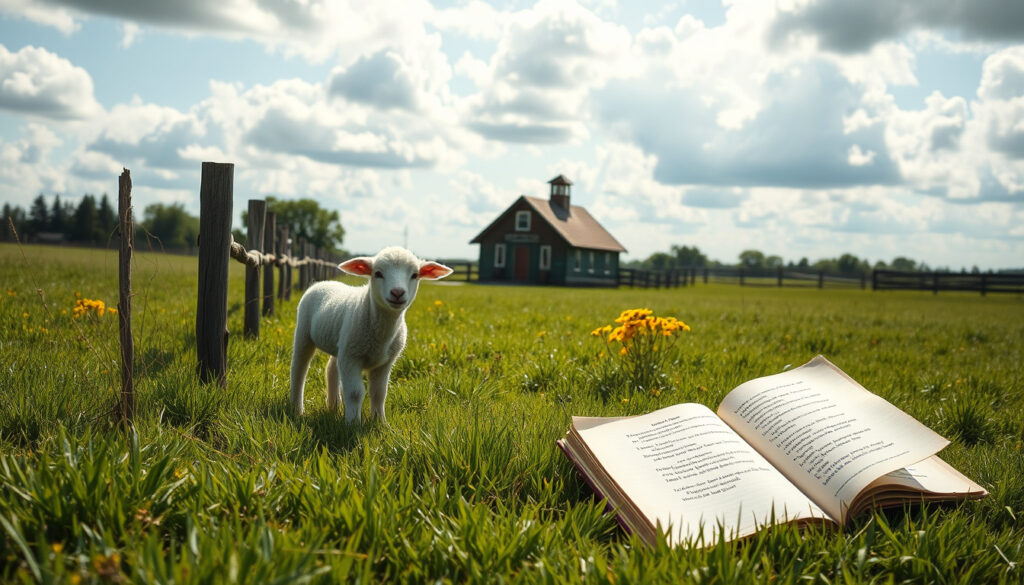
Mary Had a Little Lamb: Meaning, Full Poem & Dark Sides
Almost everyone knows the first two lines: “Mary had a little lamb, its fleece was white as snow.” But this nursery classic has a deeper history — first published in 1830 by Sarah Josepha Hale and based on a real incident from 1815 involving Mary Sawyer of Sterling, Massachusetts — and today it’s also a canvas for memes and dark reinterpretations.
First published: 1830 · Author: Sarah Josepha Hale · Original title: Mary’s Lamb · Number of stanzas: 4 · Based on true incident: Yes · First audio recording: 1877 by Thomas Edison
Quick snapshot
- Rhyme first published in 1830 by Sarah Josepha Hale (Wikipedia)
- Based on true incident involving Mary Sawyer of Sterling, Massachusetts (Smithsonian Libraries)
- First audio recording made by Thomas Edison in 1877 (Wikipedia) (Wikipedia)
- Exact identity of the real Mary remains debated (Modern Farmer)
- Whether the lamb actually followed Mary to school is uncertain (Smithsonian Libraries)
- Original wording of early versions not confirmed (Smithsonian Libraries) (Modern Farmer)
- Continued use in early childhood education (Poetry Foundation)
- Ongoing meme evolution and slang usage (Verywell Family)
- Further scholarly research on authorship debate (Smithsonian Libraries) (Poetry Foundation)
Six key facts, one consistent pattern: the rhyme’s origins are remarkably well-documented for a 19th-century nursery rhyme.
| Attribute | Value |
|---|---|
| Author | Sarah Josepha Hale |
| Year first published | 1830 |
| Original title | Mary’s Lamb |
| Number of stanzas | 4 |
| Based on true story | Yes |
| First recorded audio | 1877 by Thomas Edison |
What is the real meaning behind Mary Had a Little Lamb?
Historical origins
- The rhyme first appeared on May 24, 1830, published by Marsh, Capen & Lyon in Boston (Wikipedia)
- Sarah Josepha Hale included it in her collection Poems for Our Children later that year (Smithsonian Libraries)
- Hale, a prolific author and editor, also campaigned to establish Thanksgiving as a national holiday (Britannica)
The true story is less sanitized than the nursery rhyme suggests — a real girl, a real lamb, and a ten-year-old boy who may have written the original lines.
The real Mary Sawyer story
- Mary Elizabeth Sawyer was born in 1806 in Sterling, Massachusetts (Modern Farmer)
- In 1815, at age nine, she found an abandoned newborn lamb and nursed it back to health (Modern Farmer)
- The lamb followed Mary to the Redstone Schoolhouse in District No. 2, Sterling (Smithsonian Libraries)
- John Roulstone, a ten-year-old boy visiting the school, reportedly wrote a verse about the event — though the original slip of paper was never produced (Smithsonian Libraries)
Symbolism of the lamb
- The lamb is often interpreted as a symbol of innocence and obedience (ThoughtCo)
- A darker reading finds the image of an animal intruding into a rigid schoolroom unsettling (Modern Farmer)
- Sheep are poor mothers and often reject lambs, which adds a biological layer to the orphaned-lamb backstory (Smithsonian Libraries)
The implication: The meaning you take from “Mary Had a Little Lamb” depends largely on whether you read it as a sweet fable or as a window into 19th-century rural life — both are valid, but they lead in very different directions.
What is the full poem of Mary Had a Little Lamb?
Original text
The full four-stanza poem as published by Hale in 1830:
Mary had a little lamb,
Its fleece was white as snow;
And everywhere that Mary went,
The lamb was sure to go.It followed her to school one day,
Which was against the rule;
It made the children laugh and play,
To see a lamb at school.And so the teacher turned it out,
But still it lingered near,
And waited patiently about,
Till Mary did appear.Why does the lamb love Mary so?
The eager children cry;
Why, Mary loves the lamb, you know,
The teacher did reply.
Source: Poetry Foundation (poetry advocacy)
Variations
- A common shortened version includes only the first stanza and a repeat.
- Some versions replace “fleece was white as snow” with “fleece was white as milk” (Wikipedia)
- A competing U.K. version credits Mary Hughes of Llangollen, but that story conflicts with the 1830 publication date since Hughes was born in 1842 (Modern Farmer)
What this means: The poem we know today is almost identical to Hale’s original — a rare case where a nursery rhyme has remained remarkably stable over nearly two centuries.
What is the darkest nursery rhyme of all time?
Candidates for darkest nursery rhyme
- “Ring a Ring o’ Roses” is often linked to the Great Plague of 1665 (BBC)
- “Three Blind Mice” involves a farmer’s wife cutting off the mice’s tails with a carving knife (Wikipedia)
- “Baa Baa Black Sheep” contains tax-related complaints about medieval wool levies (Merriam-Webster)
- “Lucy Locket” and “Goosey Goosey Gander” feature violence against women and religious persecution (Atlas Obscura)
Why Mary Had a Little Lamb is not dark
- The rhyme contains no death, dismemberment, or plague references.
- The only conflict — the teacher turning out the lamb — is resolved peacefully.
- Its darkness lies in modern meme reinterpretations, not original content.
The contrast becomes clear when comparing the rhyme with genuinely dark peers. Four rhymes, one pattern: Mary is the outlier.
| Rhyme | Origin | Dark elements |
|---|---|---|
| Mary Had a Little Lamb | 1830, USA | None (innocent) |
| Ring a Ring o’ Roses | 17th century, England | Plague allusion, death (“all fall down”) |
| Three Blind Mice | 17th century, England | Violent dismemberment |
| Baa Baa Black Sheep | 18th century, England | Economic oppression, tax burden |
Separating genuinely dark rhymes from innocent ones helps us see how folklore evolves to match cultural fears — Mary’s lamb stands out precisely because it lacks the violence of its peers.
The pattern: When people ask about the “dark side” of Mary Had a Little Lamb, they’re usually projecting modern sensibilities onto a fundamentally innocent text, or confusing it with other rhymes.
What does “and that’s on Mary Had a Little Lamb” mean?
Internet meme origin
- The phrase “and that’s on Mary Had a Little Lamb” emerged on Twitter in the late 2010s as a way to emphasize a statement as indisputable truth.
- It parodies the rhyme’s matter-of-fact tone: “It followed her to school one day, which was against the rule.”
- The meme often layers onto unrelated serious or absurd claims (Verywell Family)
Usage in slang
- “And that’s on ___” is a formulaic amplifier: the blank is filled with a cultural reference to lend weight.
- Using “Mary Had a Little Lamb” adds ironic contrast because the rhyme is so innocent.
- Equivalent constructions include “and that’s on period” or “and that’s on facts.”
The catch: The meme is a perfect example of how an old text gets repurposed for completely new social functions — no dark history needed, just a shared cultural touchpoint.
What is the dark story behind Mary Mary quite contrary?
Possible origins of Mary Mary
- The rhyme “Mary, Mary, Quite Contrary” may refer to Mary I of England (“Bloody Mary”), with “cockle shells” and “silver bells” being torture devices (Historic UK)
- An alternative theory connects it to Mary, Queen of Scots, with the “garden” representing her reign.
- A third interpretation ties it to Catholicism’s “Mary garden” tradition, with “pretty maids all in a row” referring to nuns (Britannica)
Connections to Mary Had a Little Lamb
- Both rhymes feature a female protagonist named Mary, but they are unrelated in origin.
- “Mary Mary” is likely about historical queens; “Mary Had a Little Lamb” is about a specific schoolgirl.
- The shared name creates confusion in online dark-rhyme lists (The Guardian)
Why this matters: Mixing up the two Marys inflates the darkness of “Mary Had a Little Lamb” — one is genuinely dark, the other is not, and conflating them distorts our understanding of nursery rhyme history.
Timeline
- 1830 – First publication of “Mary’s Lamb” by Sarah Josepha Hale (Wikipedia)
- 1850s – Inclusion in McGuffey’s Eclectic Reader, cementing its place in American education (Smithsonian Libraries)
- 1877 – First audio recording of the rhyme by Thomas Edison (Wikipedia)
- 20th century – Widespread use in children’s education, television, and popular culture (Verywell Family)
- 2010s – Adoption as internet meme, especially the phrase “and that’s on Mary Had a Little Lamb” (BBC)
Clarity Check: Confirmed vs Unclear
Confirmed facts
- Poem written by Sarah Josepha Hale, published 1830 (Wikipedia)
- Based on true incident with Mary Sawyer (Smithsonian Libraries)
- First audio recording by Thomas Edison, 1877 (Wikipedia)
- Roud Folk Song Index number 7622 (Wikipedia)
- U.K. version with Mary Hughes conflicts chronologically (Modern Farmer)
What’s unclear
- Exact wording of John Roulstone’s original verse (Smithsonian Libraries)
- Whether Mary Sawyer’s lamb truly followed her to school (Modern Farmer)
- Which “Mary” is the definitive real subject (Wikipedia)
- Exact date of the school visit (uncertain in family recollections) (Modern Farmer)
- Whether Hale knew of Roulstone’s version before writing her poem (Smithsonian Libraries)
Expert perspectives
The only established author of ‘Mary Had a Little Lamb’ is Sarah Josepha Hale. The rhyme was likely based on an incident involving Mary Sawyer of Sterling, Massachusetts.
— Smithsonian Libraries and Archives (U.S. cultural institution) via their blog
In 1815, when she was nine, Mary Sawyer found and nursed an abandoned newborn lamb back to health. The lamb followed her to school, and a young student named John Roulstone wrote a poem about it.
— Modern Farmer (agricultural journalism) on the true story
Many nursery rhymes we think of as innocent actually have dark historical origins. ‘Ring a Ring o’ Roses’ likely refers to the Great Plague, and ‘Three Blind Mice’ describes mutilation.
— BBC (UK public broadcaster) on dark nursery rhymes
The phrase ‘and that’s on Mary Had a Little Lamb’ is a Twitter meme used to emphasize a statement as absolute fact, often with ironic contrast to the innocent nursery rhyme.
— Verywell Family (parenting resource) on modern slang usage
Summary
What began as a true story of a Massachusetts girl and her orphaned lamb became a fixture of childhood education and, later, an ironic internet meme. The rhyme’s innocence is its strength and, paradoxically, the source of its dark reinterpretations. For parents and teachers, the lesson is clear: every nursery rhyme carries a history worth questioning — and Mary’s lamb is no exception. To reduce it to a simple tune is to miss the layered story of authorship, memory, and cultural evolution. For educators in the U.S., the choice is straightforward: teach the rhyme, but also teach the real girl behind it.
Frequently asked questions
Who wrote Mary Had a Little Lamb?
The poem was written by Sarah Josepha Hale and first published in 1830. A ten-year-old boy named John Roulstone may have composed an earlier verse about the same incident, but that original text was never produced (Wikipedia)
Is Mary Had a Little Lamb a true story?
Yes, it is based on a true incident involving Mary Sawyer of Sterling, Massachusetts, who rescued a newborn lamb in 1815 that later followed her to school (Modern Farmer)
Why is Mary Had a Little Lamb so famous?
The rhyme became widely known through McGuffey’s Eclectic Reader in the 1850s and later through school performances, early recorded audio by Thomas Edison, and its inclusion in countless children’s media (Poetry Foundation)
What is the moral of Mary Had a Little Lamb?
The final stanza suggests that the lamb’s love for Mary is reciprocated — a simple lesson about kindness and loyalty: “Mary loves the lamb, you know.”
How can I teach Mary Had a Little Lamb to children?
Use the full four-stanza poem, act out the story with a stuffed lamb, and discuss the real historical background. Many educational resources recommend pairing the rhyme with the true story of Mary Sawyer (Verywell Family)
Are there any other versions of the lyrics?
Yes, some versions omit the third and fourth stanzas. The U.K. has a variant set in Llangollen, but it is historically inaccurate (Mary Hughes was born after Hale’s poem) (Modern Farmer)
What does the lamb symbolize in Mary Had a Little Lamb?
The lamb typically symbolizes innocence, companionship, and obedience. In darker readings, the animal’s intrusion into a schoolroom can be seen as unsettling, but this is a modern interpretation (ThoughtCo)
Related reading
More related posts
 Best Balance Bikes for 2 Year Olds in Ireland: Guide & Picks
 Best Toddler Car Seats 2026: Safest Picks & Buying Guide
 Where to Find Cheap Textbooks: Best Websites & Tips
 My Aviva Ireland Login: Sign In, Register, and Fix Issues
 La Marzocco Coffee Machine: Price, History, and Is It Worth It
 Thomas Brodie-Sangster Movies and TV Shows: Complete Guide
 England National Football Team Games 2026: Fixtures, TV & Squad
 Nail Salon Near Me: Pregnancy Safety, Tipping & Cost