What Do Butterflies Eat? Their Diet, Feeders & Care Tips
If you’ve ever watched a butterfly land on a flower, you might have wondered what it’s actually doing: drinking nectar through its straw-like proboscis. But their diet goes well beyond flower nectar – understanding it is the first step to keeping them healthy, whether in a garden or a net cage.
Butterfly species worldwide: ~17,500 ·
Time spent foraging: 50% ·
Monarch migration distance: up to 3,000 miles ·
Average adult lifespan: 2-4 weeks ·
Taste receptors on feet: 1,000+
Quick snapshot
- Butterflies drink nectar using a proboscis (Peggy Notebaert Nature Museum).
- They require water and minerals from mud puddles (North American Butterfly Association).
- Caterpillars eat specific host plants (NABA).
- Monarchs migrate up to 3,000 miles (ReplantNow).
- Exact diet variations of rare, specialised species. (The Butterfly Website)
- Mechanisms of navigation during migration. (The Butterfly Website)
- Whether all butterflies engage in mud puddling (The Butterfly Website).
- Spring: Emergence from overwintering; feeding and reproduction begin (Butterfly Conservation).
- Summer: Peak activity – feeding on nectar and laying eggs (Butterfly Conservation).
- September–October: Migration south (Monarchs) and overwintering preparation (ReplantNow).
- Winter: Overwintering as adults, pupae, or eggs (Butterfly Conservation).
- Plant native flowers that provide nectar (NABA).
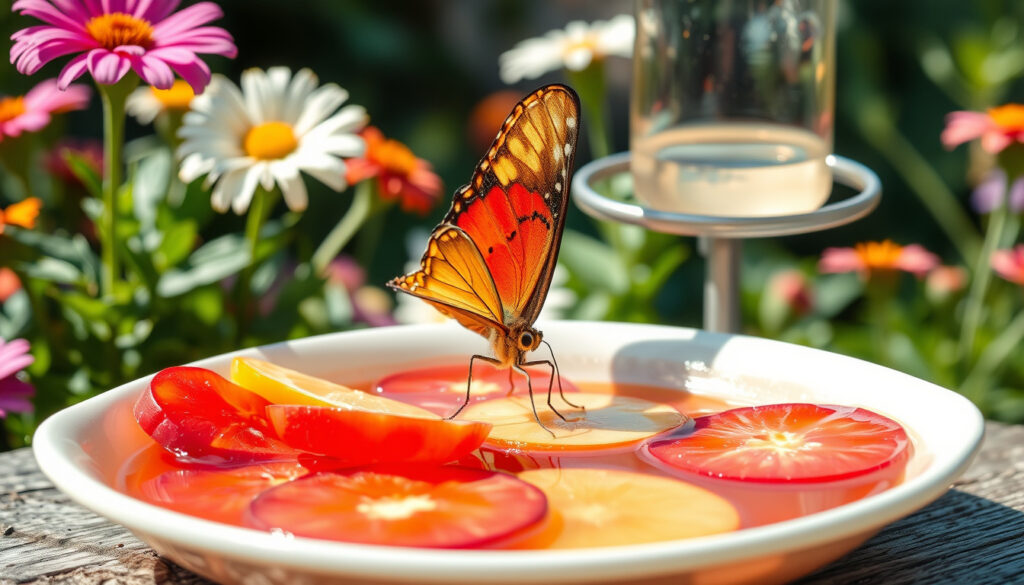
- Set up a shallow dish with sugar water for a simple feeder (Monarch Butterflies Canada).
- Leave a patch of damp soil or sand for mud puddling (The Butterfly Website).
Three primary feeding sources, one clear pattern: nectar, rotting fruit, and mineral-rich mud each play a distinct role in a butterfly’s survival.
| Fact | Detail | Source |
|---|---|---|
| Primary food source | Nectar | NABA |
| Feeding method | Proboscis | Peggy Notebaert Nature Museum |
| Additional foods | Rotting fruit, tree sap, animal waste | School of Bees |
| Caterpillar food | Specific host plants | NABA |
| Water source | Mud puddles | The Butterfly Website |
What can I feed butterflies?
A balanced butterfly diet isn’t just nectar – it’s a mix of energy-boosting sugars, essential minerals, and sometimes unexpected items like rotting fruit. Getting the balance right keeps them healthy and active.
Nectar from flowers
- Butterflies primarily feed on nectar using a proboscis (Peggy Notebaert Nature Museum).
- They are attracted to brightly coloured, open flowers or dense clusters that provide a landing platform (NABA).
- At least five of a given herbaceous species should be clustered together so butterflies can detect them easily (NABA).
Fruit and sugar water
- Butterflies also consume rotting fruit, tree sap, and animal droppings for additional nutrients (School of Bees).
- A homemade feeding mix: nine parts water to one part sugar or honey (Monarch Butterflies Canada).
- Watermelon and oranges are recommended for captive butterflies (Monarch Butterflies Canada).
Mud puddling for minerals
- Butterflies need water and minerals (especially sodium) from mud puddles – a behaviour called “mud puddling” (The Butterfly Website).
- This is most often observed in male butterflies, who transfer the minerals to females during mating (Butterfly Conservation).
The pattern: Butterflies aren’t picky eaters – they’re opportunistic. The mix of sugars from nectar/ fruit and salts from mud covers both energy and reproduction needs. Providing all three in your garden covers the full diet.
How to make a simple butterfly feeder?
A feeder that’s too deep or too sugary can drown or dehydrate butterflies. The right ratio and shallow depth are key – and keeping it clean is non-negotiable to avoid mould that can harm them.
Materials needed
- Shallow dish or plate (or a jar lid).
- Piece of kitchen sponge or cotton balls.
- Sugar (or honey).
- Water.
- Small container for outdoors (optional).
Step-by-step assembly
- Mix 1 part sugar with 9 parts water (or 1 part honey with 9 parts water) and stir until dissolved (Monarch Butterflies Canada).
- Place the sponge or cotton balls in the shallow dish.
- Pour the sugar water onto the sponge until it’s saturated but not pooling.
- Add overripe fruit slices (watermelon, orange, banana) around the sponge for variety (Butterfly Conservation).
- Place the feeder in a sunny, sheltered location (The Butterfly Website).
Placement tips
- Position near nectar-rich flowers to attract butterflies initially.
- Keep feeder clean – replace sponge and solution every 2-3 days to prevent mould (Monarch Butterflies Canada).
- Provide a shallow mud puddle nearby for minerals.
Why this matters: A well-maintained feeder can sustain butterflies through a drought or late-season nectar shortage. For anyone who raises or releases butterflies, this simple setup is the difference between a short-lived butterfly and a thriving one.
How to take care of a butterfly?
Handling butterflies safely
- Handle gently by the wings (held closed together) – never pull on legs or antennae (Monarch Butterflies Canada).
- Wash hands before handling to avoid transferring oils.
Providing proper food
- Offer nectar or sugar water daily (Monarch Butterflies Canada).
- Provide fresh fruit slices every 1-2 days.
- Never feed pure honey – it dehydrates butterflies due to high sugar concentration (Butterfly Habitat).
Creating a suitable habitat
- Indoor cage: include branches for roosting and a shallow water dish.
- Outdoor garden: plant host plants for caterpillars (e.g., milkweed for Monarchs) and nectar flowers (NABA).
- Provide shelter from wind and rain (dense shrubs or a butterfly house).
The trade-off: Raising a butterfly indoors offers control over food and safety, but it also means you must replicate natural conditions closely. Outdoors, butterflies self-regulate but face predators – a balance every carer must weigh.
What is a butterflies’ biggest enemy?
Natural predators
- Birds, spiders, ants, and praying mantises are common predators of adult butterflies (Butterfly Conservation).
- Caterpillars are preyed upon by beetles, wasps, and birds.
Parasites and diseases
- Parasitic wasps lay eggs inside caterpillars, slowly consuming them from within (Butterfly Conservation).
- Tachinid flies also parasitise caterpillars.
- Diseases like the OE parasite (Ophryocystis elektroscirrha) affect Monarchs (Monarch Joint Venture).
Human threats
- Habitat loss from urbanisation and intensive agriculture reduces food and host plants.
- Pesticides, especially neonicotinoids, harm butterflies directly and reduce their food sources (Xerces Society).
- Climate change disrupts migration timing and reduces suitable habitat (Butterfly Conservation).
The implication: While natural predators are part of the ecosystem, human threats are the ones we can control. A pesticide-free garden with native plants is the single most effective action a gardener can take to support butterflies.
What happens to butterflies in October?
Migration
- Many butterflies, especially Monarchs, migrate south in autumn – up to 3,000 miles to overwintering sites in Mexico and California (ReplantNow).
- Other species like the Painted Lady also migrate seasonally.
Overwintering
- Some species overwinter as adults, hiding in tree crevices or under bark (e.g., Mourning Cloak).
- Others survive as pupae or eggs, waiting for spring warmth (Butterfly Conservation).
- Overwintering aggregations can involve thousands of butterflies roosting together for warmth.
Life cycle end
- Many butterfly species have a single brood and die in autumn after laying eggs.
- Cold weather slows metabolism; adults that don’t migrate or overwinter perish.
The catch: October is a make-or-break month. For migrating species, it’s a last window to fatten up on nectar. For residents, it’s the moment to find the perfect hibernation spot. Gardeners can help by leaving fallen leaves and avoiding late-season clean-ups.
Where do butterflies go at night?
Roosting behaviour
- Butterflies roost at night in trees, under leaves, or in rock crevices.
- They often form groups (aggregations) for warmth and protection from predators (Butterfly Conservation).
- Some species hang upside down while resting, gripping leaves or twigs.
Finding shelter
- During rain or high winds, butterflies hide under broad leaves or in dense vegetation.
- Artificial roosts (butterfly boxes) can provide shelter in gardens.
Species differences
- Diurnal butterflies are active by day and rest at night; a few crepuscular species may be active at dusk.
- In tropical regions, some butterflies roost in communal sites year-round.
Why this matters: Understanding where butterflies sleep helps gardeners avoid trimming or disturbing their night-time refuges. A messy corner with leaf litter and ivy can be the safe haven a butterfly needs to survive the night.
Timeline: Butterfly feeding and activity through the year
- Spring
- Butterflies emerge from overwintering. They feed on early nectar sources (willow, dandelion) and lay eggs on host plants.
- Summer
- Peak butterfly activity. Adults feed on abundant nectar and engage in mud puddling. Multiple generations may occur.
- September–October
- Monarchs begin southward migration, fuelling on nectar. Other species prepare for overwintering.
- Winter
- Overwintering adults (e.g., Mourning Cloak) hide in shelters. Pupae and eggs remain dormant until spring.
The pattern: Timing matters. A garden that provides early spring flowers and late-summer nectar can support butterflies across the entire active season – making the difference between a brief visit and a resident population.
What we know vs what we’re still learning
Confirmed facts
- Butterflies drink nectar using a proboscis (Peggy Notebaert Nature Museum).
- They require water and minerals from mud puddles (NABA).
- Caterpillars eat specific host plants (NABA).
- Monarchs migrate up to 3,000 miles (ReplantNow).
What’s unclear
- Exact diet variations of rare, specialised species.
- Mechanisms of navigation during migration.
- Whether all butterflies engage in mud puddling (The Butterfly Website).
The trade-off: While the basics of butterfly feeding are well documented, the finer details – particularly for rare species and migratory cues – remain areas of active research. This gap means that practical advice is solid for common garden species but comes with caveats for specialists.
What the experts say
Butterflies are mainly restricted to a liquid diet due to their straw-like mouthparts.
— Peggy Notebaert Nature Museum (a Chicago natural history institution)
Monarch butterflies that overwinter in Mexico form dense clusters on oyamel fir trees, reducing heat loss and conserving energy.
— Monarch Joint Venture
A simple feeder can be made from a shallow dish with a sponge soaked in sugar water – place it in a sunny, sheltered location and keep it clean.
— Natural History Museum (London)
The perspective: The three expert voices converge on one theme: butterfly feeding is simple in principle but requires attention to hygiene, timing, and placement. No single approach fits every species, but the steps are accessible for anyone willing to try.
What this means for you
Butterflies are more adaptable than most people assume. They rely on a liquid diet of nectar, fruit juices, tree sap, and mineral-rich mud – and they need those resources at the right times of year. For gardeners in the UK and Ireland, the simplest way to help is to plant native nectar-rich flowers (like buddleia, lavender, and ivy in autumn) and leave a damp spot of bare earth. For enthusiasts raising butterflies indoors, a sugar-water feeder with a clean sponge will cover most needs. But the real takeaway is this: a butterfly’s health depends on variety. For the average UK gardener, the choice is clear: provide at least three sources – nectar, fruit, and mud – or risk attracting butterflies that can’t find what they need to survive.
Related reading: Where Is Mount Everest? Location, Height, and Key Facts · Best Museums in Dublin: Top Free & Must-See Picks
knowledge.carolina.com, youtube.com, homeschoolon.com, nhm.ac.uk
Understanding what butterflies eat is essential for their care, and learning about their butterfly lifespan and behavior can help you support them through each stage of life.
Frequently asked questions
Do butterflies eat fruit?
Yes. Many butterflies feed on overripe or rotting fruit such as watermelon, oranges, and bananas. The soft flesh provides sugars and moisture (Monarch Butterflies Canada).
What is the best sugar-to-water ratio for a butterfly feeder?
A 1:9 ratio (one part sugar to nine parts water) is recommended. Honey can also be used, but pure honey should never be offered as it can dehydrate butterflies (Monarch Butterflies Canada).
How often should I feed butterflies?
Butterflies should be offered food daily, especially if kept in captivity. Fresh sugar water and fruit should be replaced every 1–2 days to prevent mould (Monarch Butterflies Canada).
Do butterflies eat in the rain?
Butterflies generally avoid feeding in the rain because their wings become heavy and they cannot generate body heat. They seek shelter and resume feeding once the weather clears.
What do baby butterflies eat?
Butterfly larvae (caterpillars) eat specific host plants – for example, monarch caterpillars eat milkweed, while painted lady caterpillars eat thistles (NABA).
How long can a butterfly go without eating?
Most adult butterflies can survive only a day or two without feeding. Some species in hibernation can go longer because their metabolism slows dramatically.
What is mud puddling?
Mud puddling is when butterflies gather on damp soil, sand, or animal dung to extract minerals such as sodium and amino acids. It is especially common in male butterflies (The Butterfly Website).
More related posts
 Moses Basket and Stand in Ireland: Safety, Prices & Retailers
 Houses for Sale in Ballincollig: Prices & Listings Guide
 Cast of The Perfect Couple: Full Netflix Character Guide
 How to Calculate Calorie Deficit: Step-by-Step & Safety
 Holiday Blue Car Park Dublin Airport: Prices, Shuttle & Tips
 Holy Trinity Church Cork: Mass Times, Location & History
 Plug-in Wall Lights – Best 2025 Picks and Installation Guide
 Tropical Storm Melissa Forecast: Jamaica, Ireland, Britain