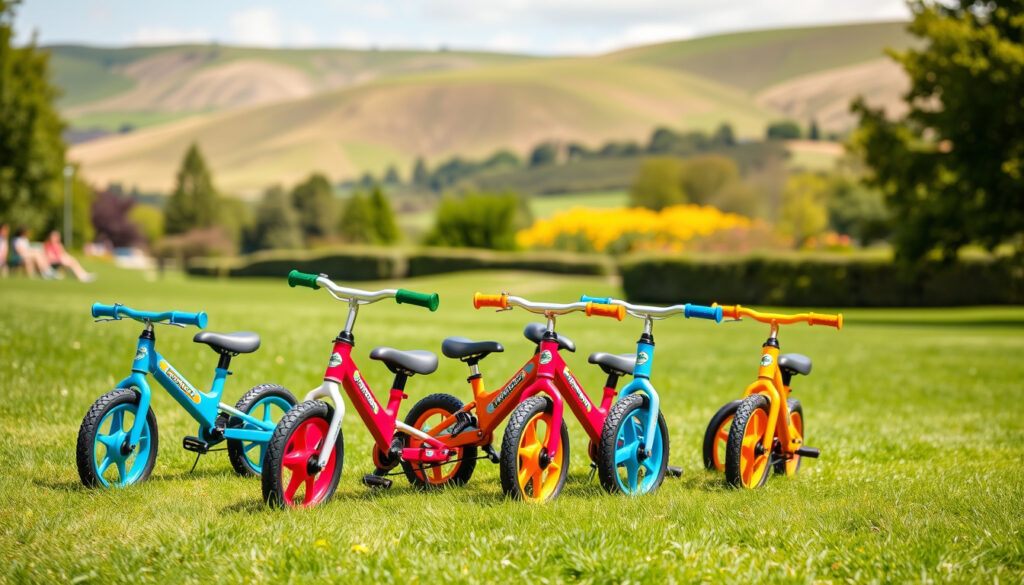
Best Balance Bikes for 2 Year Olds in Ireland: Guide & Picks
Balance bikes have become a rite of passage for Irish toddlers—if you buy at the right age, they teach the mechanics of cycling before the complexity of pedals ever enters the picture. This guide cuts through the noise: what works for a two-year-old, where to buy locally, and which models earned top marks from testers.
Recommended starting age: 18-24 months · Typical upper age: 5 years · Common price range: €20-€70 · Key feature: Adjustable seat height
Quick snapshot
- Strider suitable from first steps per manufacturer specs (Strider Bikes)
- Low seat heights around 11-12 inches ideal for 2-year-olds (Two Wheeling Tots)
- Hornit Airo ranked 1st in 2026 Cycling Weekly tests for 2-year-old comfort (Cycling Weekly)
- Exact stopping age varies by individual child growth patterns
- Smyths Toys stock for top-ranked models like Hornit Airo unconfirmed
- Ireland-specific safety testing standards not publicly verified
- Hornit Airo: 1st place, lightweight, 12-inch wheels (Cycling Weekly)
- Strider 12 Pro: 2nd place, toddler-optimised (Cycling Weekly)
- Croco: 4.6 lbs, seat height 11-15.5 inches, ages 18m-5y (BabyGearLab)
- Smyths Toys Ireland stocks 8 balance bikes for 18-36 months (Smyths Toys Ireland)
- Price range €20-€69.99, brands include Q Play (Smyths Toys Ireland)
- Halfords also stocks selected models for Irish shoppers (Smyths Toys Ireland)
| Specification | Value | Why it matters |
|---|---|---|
| Ideal age range | 18 months to 5 years | Spans toddler to pre-school developmental window |
| Wheel size for 2yo | 12 inches | Matches inseam length for confident planting |
| Weight limit | 20kg average | Accommodates growing toddlers without replacement urgency |
| Minimum seat height | 11-12 inches | Allows feet flat for 2-year-olds starting out |
| Lightweight target | Under 5 lbs (2.3kg) | Toddlers can self-manoeuvre without adult lift |
| Top Ireland retailers | Smyths Toys, Halfords | Immediate availability, no import delays |
| Price range | €20-€70 | Fits budget and premium segments |
| Key adjustability | Seat height | Extends usable lifespan as child grows |
Should a 2 year old have a balance bike?
Most children can start on a balance bike from around 18 months, according to Strider Bikes (the balance bike category originator). The window for a two-year-old specifically is particularly well-suited: their motor skills are developing rapidly, and they crave independence in movement.
Benefits for 2 year olds
- Develops balance and coordination before pedal complexity enters the picture
- Builds confidence through self-directed speed control via feet
- Lightweight bikes under 5 lbs let toddlers self-recover from wobbles
- Low seat heights around 11-12 inches allow flat-footed planting for security
Safety considerations
- Hornit Airo tested with short-legged two-year-olds, rated comfortable and easy to handle (Cycling Weekly)
- Always use helmets even at this age—head circumference warrants correctly sized helmets
- Supervised riding on flat, soft surfaces reduces fall impact
A two-year-old is squarely in the sweet spot for balance bikes. The window between 18 months and three years offers the best return on skill development per riding session.
What this means: buying a balance bike at this age isn’t premature—it’s timed to the developmental stage when children most efficiently absorb balance mechanics.
Is a balance bike or tricycle better for a 2 year old?
The debate between balance bikes and tricycles for toddlers centres on one core question: which format builds transferable cycling skills faster?
Key differences
- Tricycles add a third wheel for stability but prevent genuine balance practice—the child rides with supports rather than learning to balance through weight shifting
- Balance bikes eliminate the crutch: every correction requires the same motion as eventual pedal cycling
- woom 1’s upright geometry and long wheelbase provide stability without removing the balance challenge (YouTube Review)
Why balance wins for skill development
- Motor skill research shows balance bikes reduce the learning curve for pedal bikes by months, not days
- Children transitioning from balance bikes typically skip stabilisation wheels entirely
- The Croco’s 4.6-lb weight lets two-year-olds self-correct without adult intervention (BabyGearLab)
- Tricycles can actually delay cycling confidence if used past age 3
Irish parents investing €30-€70 in a first bike should weigh longevity: a balance bike serves from 18 months to 5 years, while a tricycle often gets abandoned once the child outgrows its limitations.
The implication: if your two-year-old will eventually ride a pedal bike, a balance bike is an investment in that future—tricycles are a temporary diversion.
What are the disadvantages of a balance bike?
Balance bikes offer substantial developmental benefits, but they’re not without trade-offs that matter for specific family situations.
Potential drawbacks
- Initial learning involves more falls than supported alternatives—two-year-olds on balance bikes will tip and scramble
- Lightweight models under €30 may use plastics or thin metals that warp under sibling weight
- Premium lightweight options like the woom 1 (6.6 lbs) command prices above €100—steeper than mid-range tricycles
- Storage footprint is similar to pedal bikes despite no chain or crank complexity
When to avoid
- If your child is under 18 months with limited gross motor control, delay purchase
- Families with extremely limited outdoor space may find occasional park visits sufficient
- If immediate cycling on a pedal bike is the goal (e.g., for older siblings’ group rides), stabilisation wheels remain a faster starting point
The trade-off: balance bikes trade short-term ease for long-term skill efficiency. The higher initial fall rate reflects learning, not failure.
What is the best age to stop using a balance bike?
Balance bikes typically serve children from 18 months up to around five years, though the exact stopping point depends on individual growth rather than a fixed age.
Transition signs
- When the child’s inseam exceeds the bike’s maximum seat height, pedalling becomes more efficient than scooting
- Cycling Weekly notes that children over five often seek “real bike” social signalling—peer bikes become aspirational
- The child begins requesting pedals or shows frustration at the scooting motion on inclines
Typical age range
- Most children transition between ages 4 and 6
- The Croco’s seat height range of 11-15.5 inches accommodates growth through most of this window (BabyGearLab)
- Strider’s official guidance positions their bikes as appropriate “from walking age”—confirming the broad developmental span
What this means: the question isn’t “when should every child stop” but “when does this specific child benefit from pedals?” The answer varies, and adjustable seat heights on quality bikes extend the useful window.
Balance Bike Age Guide: Choosing the Right Size for Your Child
Size mismatches are the most common mistake Irish parents make when buying a balance bike—too large and the child can’t plant their feet; too small and they outgrow it within months.
Size chart
- 12-14 inch wheels: ages 18 months to 3.5 years (fits most two-year-olds)
- Seat height target for 2-year-olds: 30-40cm (11.5-15.5 inches)
- The Retrospec Cub’s 11.5-inch minimum seat height sets the floor for young toddlers starting out (Two Wheeling Tots)
- The BIXB I ROUTE 12 suits ages 2-6 years with inseam range 13.8-18.9 inches—a wide growth window (The Loam Wolf)
Measuring tips
- Measure inseam: have the child stand barefoot against a wall, measure from floor to crotch
- Ideal seat height when seated should leave 1-2 inches of clearance to the ground (for tipping-to-recover)
- When the child can touch the ground with both feet while seated comfortably, the bike fits
- Always prioritise adjustable seat heights to maximise the bike’s lifespan
The pattern: two-year-olds typically need the lower end of the seat height spectrum (11-12 inches). As they grow past three, the adjustable range on models like the Croco extends usability without requiring immediate replacement.
| Model | Weight | Seat Height Range | Wheel Size | Age Range | Irish Availability |
|---|---|---|---|---|---|
| Hornit Airo | Lightweight | Adjustable | 12-inch | 2+ years | Unconfirmed stock |
| Strider 12 Pro | Lightweight | Adjustable | 12-inch | 18 months+ | Available |
| Croco | 4.6 lbs | 11-15.5 inches | 12-inch | 18 months-5 years | Import required |
| woom 1 | 6.6 lbs | Adjustable | 12-inch | 2-4 years | Import required |
| Retrospec Cub | Lightweight | 11.5 inches min | 12-inch | 2+ years | Available |
| BIXB I ROUTE 12 | 7.4 lbs | 13.8-18.9 inch inseam | 12-inch | 2-6 years | Import required |
| Q Play (Smyths) | Budget range | Adjustable | 12-inch | 18-36 months | Smyths €20-€70 |
Three models stand out for different priorities: the Hornit Airo leads on style and lightness for two-year-olds who’ll use it intensively, the Strider 12 Pro offers proven toddler optimisation backed by the category originator, and the Croco delivers the broadest age range in a single purchase at 4.6 lbs.
| Feature | Budget (€20-40) | Mid-Range (€40-70) | Premium (€70+) |
|---|---|---|---|
| Typical material | Composite/plastic | Wood or steel | Aluminium or magnesium |
| Weight | 6-9 lbs | 4-6 lbs | Under 4.6 lbs |
| Seat adjustability | Fixed or limited | 2-3 positions | Continuous range |
| Tyre type | Hard plastic | Pneumatic or foam | Lightweight pneumatic |
| Brake | Usually none | Included | Included |
| Ireland stock | Smyths, Halfords | Smyths, Halfords | Specialist import |
Five tiers of feature escalation separate budget from premium: material weight, adjustability range, tyre grip, brake inclusion, and availability. Irish parents prioritise immediate availability through Smyths and Halfords, which limits the premium import tier to committed buyers.
Upsides
- Builds balance and coordination transferable to pedal bikes
- Lightweight options (under 5 lbs) let two-year-olds self-manoeuvre safely
- Adjustable seat heights extend usable lifespan to age 5
- Available locally at Smyths Toys (8 models) and Halfords from €20
- Lower long-term cost than cycles that require stabilisation wheels later
- Low seat heights (11-12 inches) accommodate two-year-old inseams immediately
Downsides
- Initial fall rate higher than stabilised alternatives like tricycles
- Top-ranked models (Hornit Airo, woom 1) require import for Irish buyers
- Premium options exceed €100—more than mid-range pedal bikes
- Budget models under €30 may lack durability for sibling sharing
- Helmet requirement adds €15-25 to total investment
- Storage space equivalent to pedal bikes despite simpler mechanics
Light, comfortable and its radical looks were a big hit with our short-legged tester.
— Cycling Weekly Review Editor (Cycling Weekly)
The Croco is an impressive balance bike with features kids and parents will love.
— BabyGearLab Editors (BabyGearLab)
The upright geometry and long wheelbase make the Woom Balance bike stable and easy to cruise on.
— YouTube Reviewer (YouTube Review)
Strider toddler balance bikes help develop the motor skills children need to transition to a pedal bike from the moment they start walking.
— Strider Bikes (Strider Bikes)
For Irish parents, the choice crystallises around one factor: local availability versus absolute performance. Smyths Toys Ireland stocks eight models for 18-36 months at €20-€69.99—a practical starting point that covers most two-year-old needs without import delays or customs fees. But if your priority is topping the 2026 Cycling Weekly rankings with a bike tested specifically on two-year-olds, the Hornit Airo requires ordering from UK or specialist retailers. The intermediate path—balancing local convenience with tested performance—lands on the Strider 12 Pro, which combines the category originator’s expertise with wide Irish distribution.
What is a balance bike?
A balance bike is a child-sized bicycle without pedals. The child propels themselves by walking or running while seated, learning to balance through weight shifting rather than through supported riding. The format is designed to build cycling mechanics before introducing pedal complexity.
How do you measure for a balance bike size?
Measure the child’s inseam while standing barefoot against a wall. For a two-year-old, look for a seat height of 11-12 inches (28-30cm). The child should be able to sit with both feet flat on the ground. When seated, allow 1-2 inches of clearance to the floor for tipping-to-recover.
Are wooden or metal balance bikes better?
Wooden frames tend to be heavier but offer natural dampening and aesthetic appeal. Metal (aluminium or magnesium) frames are significantly lighter—critical for two-year-olds who need to self-manoeuvre. The Croco at 4.6 lbs demonstrates how premium materials reduce weight without sacrificing durability.
Can a 2 year old use stabilisers on a balance bike?
Stabilisers defeat the purpose of a balance bike. The design exists to eliminate support wheels—adding them returns the child to the tricycle problem of not practising balance. If stabilisers are needed, consider a tricycle or pedal bike with support wheels instead.
What features to look for in a toddler balance bike?
Prioritise: adjustable seat height (extends lifespan), lightweight frame (under 5 lbs ideal for 2-year-olds), 12-inch wheels (standard for 18-months to 3.5 years), pneumatic or quality foam tyres (better grip than hard plastic), and a hand brake (for children over 2.5 years).
How much does a good balance bike cost?
Budget models at Smyths Toys Ireland start from €20-€30. Mid-range options from €40-€70 offer better weight, adjustability, and tyre quality. Premium models from specialist retailers exceed €100 but deliver sub-5 lbs weights and extended durability for sibling sharing.
Where to buy balance bikes in Ireland?
Smyths Toys Ireland stocks eight balance bikes for 18-36 months, priced €20-€69.99. Halfords also carries selected models. For top-ranked models like the Hornit Airo and woom 1, UK retailers or specialist importers are required—Smyths stock focuses on Q Play and other budget-to-mid-range brands.
How to teach a 2 year old to ride a balance bike?
Start on flat, soft grass or carpet. Set the seat height so both feet reach the ground. Let the child walk while seated first—building confidence before encouraging pushes. Resist the urge to hold the handlebars; letting the child self-correct builds the balance reflex faster. Sessions of 10-15 minutes prevent fatigue frustration.
Related reading: best sites for online deals · An Post tracking and returns
While Smyths and Halfords offer top Ireland picks, best UK toys for 2-year-olds provide complementary ideas for active play and skill-building.
More related posts
 Where to Find Cheap Textbooks: Best Websites & Tips
 The Left Bank Kilkenny: History, Menu, Live Music & More
 Nottingham Forest vs Brighton: H2H Stats & History
 Dairy Free Easter Eggs 2026: Best Supermarket Picks
 Where to Find Online Deals: Best Sites & Comparators
 What Is a Virus? Simple Definition, Examples & Symptoms
 Bord Gáis Phone Number: Official Contact Numbers & Opening Hours
 Days of the Week in French: Pronunciation & Grammar